.avif)
Clay Buyer Scoring Attributes and Implementation: B2B Guide

Clay buyer scoring attributes and implementation rank B2B accounts by fit before outreach to prioritize high-potential leads in lead generation workflows. B2B pipelines lose efficiency when sales teams contact unqualified leads, with industry research on sales funnel performance showing up to 73% of typical funnel leads lack qualification. Clay buyer scoring attributes and implementation address this in B2B sales by integrating firmographic, technographic, and intent data for precise B2B lead generation.
Why Clay buyer scoring attributes and implementation matter for modern lead generation
Lead generation requires scoring to avoid guesswork in B2B sales. Clay buyer scoring attributes and implementation prioritize accounts at the data layer before outreach begins. Clay pulls data from 75+ providers through waterfall enrichment, achieving over 80% data completeness in workflows compared to 40-50% from single sources. This supports accurate buyer scoring attributes and implementation for B2B lead generation. For teams stuck at low monthly revenue, this video on scaling revenue through lead scoring and qualification shows how proper lead prioritization removes the bottleneck that blocks predictable growth.
The shift from volume to precision
B2B lead generation previously emphasized volume through high email and dial volumes. Cold reply rates now range from 1-3% due to inbox saturation.
What scoring actually does for sales
Pre-scored leads entering discovery calls allow reps to focus on pain points, shortening sales cycles by 30-40% in Chrysales coaching for lean teams.
Core buyer scoring attributes every B2B sales team should track

Buyer scoring strength depends on tracked attributes in clay buyer scoring attributes and implementation. Effective models use 12-20 attributes across firmographic, technographic, and intent categories for B2B sales.
Firmographic attributes
Firmographic attributes describe company characteristics as the foundation of B2B lead scoring models.
- Company size by employee count and revenue band
- Industry and sub-industry
- Funding stage and amount raised
- Geographic location
- Growth rate by headcount change in last 12 months
A 15-person consulting firm requires a different sales motion than a 1,500-person enterprise in B2B sales.
Technographic attributes
Technographic attributes identify software usage in accounts. Clay sources technographic data from BuiltWith and Wappalyzer for buyer scoring attributes and implementation.
Intent and behavioral signals
Intent signals include job posting changes, website visits, content downloads, and funding rounds. Clay parses LinkedIn job postings for keywords like "sales hiring" or "GTM lead," signaling purchase readiness 60-90 days ahead.
Step-by-step Clay enrichment workflow for accurate scoring
Clay enrichment workflows for accurate scoring follow a fixed sequence in clay buyer scoring attributes and implementation. Accurate scoring requires all steps for B2B lead generation, especially when Clay enrichment workflows are integrated into modern sales systems that combine automation with strategy.
Step 1: Define your ICP with hard criteria
Teams define ICP with measurable terms before Clay use. Usable ICP examples include "B2B SaaS companies with 50-200 employees, US or EU based, raised Series A in last 24 months."
Step 2: Build the source list
Initial accounts come from Apollo, LinkedIn Sales Navigator, or scrapers at 2-5x target list size for filtering in lead generation.
Step 3: Run waterfall enrichment
Providers stack in priority order, such as Apollo then Hunter then Clearbit for email. Coverage lifts from 50% to 85%+ through waterfall logic.
Step 4: Apply scoring formulas
Clay formula columns assign points in buyer scoring attributes and implementation, such as:
- Company size match: 20 points
- Industry match: 15 points
- Tech stack match: 15 points
- Recent funding: 20 points
- Hiring sales roles: 30 points
Accounts above 70 points go to closers; 40-69 to nurture; below 40 drop.
Step 5: Sync to CRM
Scored accounts sync to HubSpot, Salesforce, or Pipedrive with scores as custom fields for instant rep visibility in B2B sales.
Connecting Clay buyer scoring attributes and implementation to sales conversations
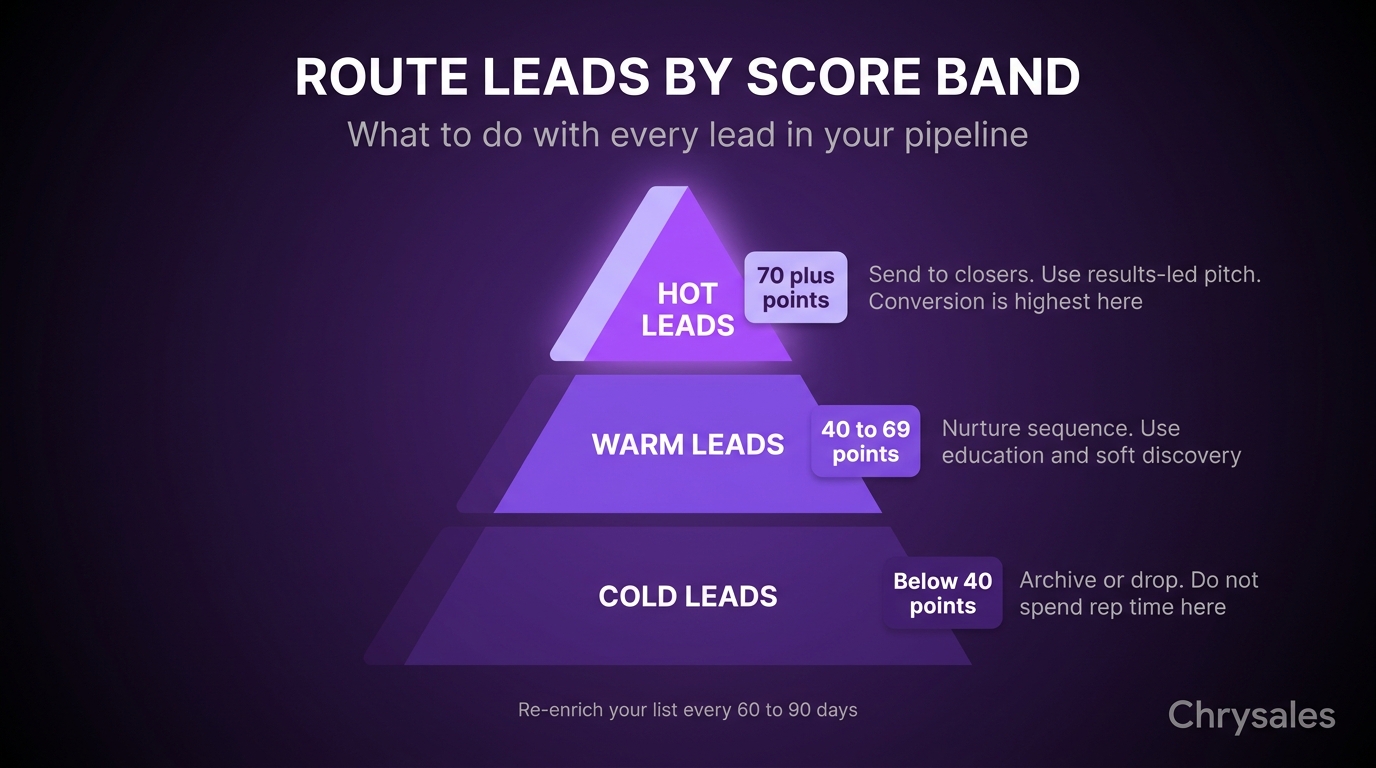
Clay buyer scoring attributes and implementation connect to sales conversations when reps adapt calls to scores. Scoring data drives revenue when integrated into discovery and pitches.
How high-score leads change the discovery call
High-score leads at 90+ provide reps with company size, tech stack, funding, and pain data. Discovery calls shift to specifics like "Company raised Series B and posted three sales roles; what drives that hire?" Meeting-to-opportunity conversion doubles.
Adjusting the pitch by score band
Pitches vary by score in client acquisition. High-intent accounts receive results-led pitches; medium scores use educational discovery with less pressure. Sales training overlooking scores results in flat win rates, a pattern confirmed by benchmark data on B2B sales conversion.
Objection handling improves with data
Scoring reveals competitor tools for advance preparation or layoffs for budget anticipation. Chrysales creates objection scripts linked to scoring tiers in closing systems for client acquisition workflows.
Common mistakes in Clay GTM engineering and how to fix them
Teams fail in Clay GTM engineering despite workflows due to execution gaps in lead generation. These common execution gaps in Clay GTM engineering include lack of sales input and over-engineering.
Mistake 1: Scoring without sales input
Marketing models without sales input ignore closed-deal realities. Closers define good leads from win-loss data in last 12 months before model building.
Mistake 2: Over-engineering the workflow
Workflows with 40 columns and 30 attributes slow speed. Begin with 8-12 attributes, deploy, and iterate on results for GTM efficiency.
Mistake 3: Ignoring data decay
B2B data decays 30% per year from growth, role changes, and tech shifts. Re-enrich lists every 60-90 days.
Mistake 4: No feedback loop from closed deals
Closed deals update models; three of five wins from 60-70 scores indicate weight adjustments monthly.
Mistake 5: Treating Clay as a replacement for sales skill
Clay handles lead scoring but not closing. Sales training combined with data produces client acquisition; skipping training limits results, as Chrysales observes.
Building a repeatable lead generation system around Clay
Repeatable lead generation systems around Clay include documentation, automation, and ownership beyond single workflows. The principles for building a repeatable lead generation system apply directly here, and you can also see how to build repeatable lead generation systems with Clay for a deeper walkthrough on creating sales systems clients come to.
Document the full workflow
Documentation covers source criteria, enrichment order, scoring formulas, thresholds, CRM sync, and assignment for new hire execution.
Automate the handoff
Clay webhooks route high-score leads to outreach tools like Smartlead; medium to nurture; low to archive without manual steps.
Assign clear ownership
One person owns Clay workflow, one outreach, one closing. Chrysales installs Chief of Staff roles for lead generation maintenance in teams of 1-50.
Measure what matters
Weekly metrics include:
- Score-to-meeting conversion rate
- Meeting-to-opportunity rate by score band
- Closed revenue by score tier
Highest tiers convert at 3-5x lowest; otherwise, adjust models for B2B lead generation.
Frequently asked questions
Q1: How many attributes should a Clay scoring model use?
Clay scoring models start with 8-12 attributes across firmographic, technographic, and intent categories. More than 20 adds noise; iterate every 30-60 days on closed-deal data.
Q2: How long does it take to implement Clay buyer scoring attributes and implementation properly?
Basic Clay buyer scoring attributes and implementation workflows take 1-2 weeks with defined ICP. Production systems with sync and processes require 4-6 weeks; win-loss analysis reduces delays.
Q3: Can Clay replace traditional sales training?
Clay does not replace sales training. Clay enhances lead quality; reps require discovery, pitches, and objections skills. Scored data plus sales training maximizes gains in B2B sales.
Q4: What is the difference between Clay and platforms like 6sense?
Clay provides flexible GTM engineering for lean teams with data control. 6sense offers enterprise ABM with predictive intent for larger budgets.
Q5: How often should scoring models be updated?
Scoring weights review monthly; data re-enriches every 60-90 days as B2B data decays 30% yearly. Static models lose accuracy in two quarters.
Q6: Does Clay work for service businesses, not just SaaS?
Clay supports service businesses like consulting firms for client acquisition. Scoring emphasizes growth signals over technographics across industries.
Clay buyer scoring attributes and implementation rank B2B accounts by fit before outreach to prioritize high-potential leads in lead generation workflows. B2B pipelines lose efficiency when sales teams contact unqualified leads, with industry research on sales funnel performance showing up to 73% of typical funnel leads lack qualification. Clay buyer scoring attributes and implementation address this in B2B sales by integrating firmographic, technographic, and intent data for precise B2B lead generation.
Why Clay buyer scoring attributes and implementation matter for modern lead generation
Lead generation requires scoring to avoid guesswork in B2B sales. Clay buyer scoring attributes and implementation prioritize accounts at the data layer before outreach begins. Clay pulls data from 75+ providers through waterfall enrichment, achieving over 80% data completeness in workflows compared to 40-50% from single sources. This supports accurate buyer scoring attributes and implementation for B2B lead generation. For teams stuck at low monthly revenue, this video on scaling revenue through lead scoring and qualification shows how proper lead prioritization removes the bottleneck that blocks predictable growth.
The shift from volume to precision
B2B lead generation previously emphasized volume through high email and dial volumes. Cold reply rates now range from 1-3% due to inbox saturation.
What scoring actually does for sales
Pre-scored leads entering discovery calls allow reps to focus on pain points, shortening sales cycles by 30-40% in Chrysales coaching for lean teams.
Core buyer scoring attributes every B2B sales team should track
Buyer scoring strength depends on tracked attributes in clay buyer scoring attributes and implementation. Effective models use 12-20 attributes across firmographic, technographic, and intent categories for B2B sales.
Firmographic attributes
Firmographic attributes describe company characteristics as the foundation of B2B lead scoring models.
- Company size by employee count and revenue band
- Industry and sub-industry
- Funding stage and amount raised
- Geographic location
- Growth rate by headcount change in last 12 months
A 15-person consulting firm requires a different sales motion than a 1,500-person enterprise in B2B sales.
Technographic attributes
Technographic attributes identify software usage in accounts. Clay sources technographic data from BuiltWith and Wappalyzer for buyer scoring attributes and implementation.
Intent and behavioral signals
Intent signals include job posting changes, website visits, content downloads, and funding rounds. Clay parses LinkedIn job postings for keywords like "sales hiring" or "GTM lead," signaling purchase readiness 60-90 days ahead.
Step-by-step Clay enrichment workflow for accurate scoring
Clay enrichment workflows for accurate scoring follow a fixed sequence in clay buyer scoring attributes and implementation. Accurate scoring requires all steps for B2B lead generation, especially when Clay enrichment workflows are integrated into modern sales systems that combine automation with strategy.
Step 1: Define your ICP with hard criteria
Teams define ICP with measurable terms before Clay use. Usable ICP examples include "B2B SaaS companies with 50-200 employees, US or EU based, raised Series A in last 24 months."
Step 2: Build the source list
Initial accounts come from Apollo, LinkedIn Sales Navigator, or scrapers at 2-5x target list size for filtering in lead generation.
Step 3: Run waterfall enrichment
Providers stack in priority order, such as Apollo then Hunter then Clearbit for email. Coverage lifts from 50% to 85%+ through waterfall logic.
Step 4: Apply scoring formulas
Clay formula columns assign points in buyer scoring attributes and implementation, such as:
- Company size match: 20 points
- Industry match: 15 points
- Tech stack match: 15 points
- Recent funding: 20 points
- Hiring sales roles: 30 points
Accounts above 70 points go to closers; 40-69 to nurture; below 40 drop.
Step 5: Sync to CRM
Scored accounts sync to HubSpot, Salesforce, or Pipedrive with scores as custom fields for instant rep visibility in B2B sales.
Connecting Clay buyer scoring attributes and implementation to sales conversations
Clay buyer scoring attributes and implementation connect to sales conversations when reps adapt calls to scores. Scoring data drives revenue when integrated into discovery and pitches.
How high-score leads change the discovery call
High-score leads at 90+ provide reps with company size, tech stack, funding, and pain data. Discovery calls shift to specifics like "Company raised Series B and posted three sales roles; what drives that hire?" Meeting-to-opportunity conversion doubles.
Adjusting the pitch by score band
Pitches vary by score in client acquisition. High-intent accounts receive results-led pitches; medium scores use educational discovery with less pressure. Sales training overlooking scores results in flat win rates, a pattern confirmed by benchmark data on B2B sales conversion.
Objection handling improves with data
Scoring reveals competitor tools for advance preparation or layoffs for budget anticipation. Chrysales creates objection scripts linked to scoring tiers in closing systems for client acquisition workflows.
Common mistakes in Clay GTM engineering and how to fix them
Teams fail in Clay GTM engineering despite workflows due to execution gaps in lead generation. These common execution gaps in Clay GTM engineering include lack of sales input and over-engineering.
Mistake 1: Scoring without sales input
Marketing models without sales input ignore closed-deal realities. Closers define good leads from win-loss data in last 12 months before model building.
Mistake 2: Over-engineering the workflow
Workflows with 40 columns and 30 attributes slow speed. Begin with 8-12 attributes, deploy, and iterate on results for GTM efficiency.
Mistake 3: Ignoring data decay
B2B data decays 30% per year from growth, role changes, and tech shifts. Re-enrich lists every 60-90 days.
Mistake 4: No feedback loop from closed deals
Closed deals update models; three of five wins from 60-70 scores indicate weight adjustments monthly.
Mistake 5: Treating Clay as a replacement for sales skill
Clay handles lead scoring but not closing. Sales training combined with data produces client acquisition; skipping training limits results, as Chrysales observes.
Building a repeatable lead generation system around Clay
Repeatable lead generation systems around Clay include documentation, automation, and ownership beyond single workflows. The principles for building a repeatable lead generation system apply directly here, and you can also see how to build repeatable lead generation systems with Clay for a deeper walkthrough on creating sales systems clients come to.
Document the full workflow
Documentation covers source criteria, enrichment order, scoring formulas, thresholds, CRM sync, and assignment for new hire execution.
Automate the handoff
Clay webhooks route high-score leads to outreach tools like Smartlead; medium to nurture; low to archive without manual steps.
Assign clear ownership
One person owns Clay workflow, one outreach, one closing. Chrysales installs Chief of Staff roles for lead generation maintenance in teams of 1-50.
Measure what matters
Weekly metrics include:
- Score-to-meeting conversion rate
- Meeting-to-opportunity rate by score band
- Closed revenue by score tier
Highest tiers convert at 3-5x lowest; otherwise, adjust models for B2B lead generation.
Frequently asked questions
Q1: How many attributes should a Clay scoring model use?
Clay scoring models start with 8-12 attributes across firmographic, technographic, and intent categories. More than 20 adds noise; iterate every 30-60 days on closed-deal data.
Q2: How long does it take to implement Clay buyer scoring attributes and implementation properly?
Basic Clay buyer scoring attributes and implementation workflows take 1-2 weeks with defined ICP. Production systems with sync and processes require 4-6 weeks; win-loss analysis reduces delays.
Q3: Can Clay replace traditional sales training?
Clay does not replace sales training. Clay enhances lead quality; reps require discovery, pitches, and objections skills. Scored data plus sales training maximizes gains in B2B sales.
Q4: What is the difference between Clay and platforms like 6sense?
Clay provides flexible GTM engineering for lean teams with data control. 6sense offers enterprise ABM with predictive intent for larger budgets.
Q5: How often should scoring models be updated?
Scoring weights review monthly; data re-enriches every 60-90 days as B2B data decays 30% yearly. Static models lose accuracy in two quarters.
Q6: Does Clay work for service businesses, not just SaaS?
Clay supports service businesses like consulting firms for client acquisition. Scoring emphasizes growth signals over technographics across industries.
Discover the latest tips
View All.avif)
Chrysales was formed from the words "chrysalis" the stage where a caterpillar transforms into a butterfly and "sales".
It stands for one thing: sales transformation.Because scaling doesn’t happen by doing more of the same. Scaling only happens when you go through real transformation in your systems, your offer, team and the way you sell.
.avif)


