.avif)
Best Integrated Media Services for B2B Business Growth
Best integrated media services business growth means connecting marketing, lead generation, B2B sales, and sales training into one system that helps you get more client acquisition and better GTM results. Picture this: You've got a marketing team running ads, a sales team making calls, and a content person posting on LinkedIn. All three are working hard, but nothing connects. Your ads bring traffic that never converts. Your sales team chases leads that went cold weeks ago. Your content gets likes but zero booked calls. Sound familiar? That's what happens when your growth systems don't talk to each other. The best integrated media services business growth fix this by building one system where everything works together, but most companies are looking in the wrong place.
Why Most Growth Strategies Fall Apart at the Seams
Most B2B companies treat marketing and sales like two different departments living in separate buildings. Marketing generates leads, dumps them in a spreadsheet, and calls it a day. Sales picks through the list, complains half the contacts are bad, and the cycle repeats. Nobody wins. The real problem isn't that either team is bad at their job. It's that there's no system connecting the work. Your marketing might be great at getting attention, but if your sales process can't close, you're just spending money on awareness. Your sales team might be incredible closers, but if the leads coming in are cold or unqualified, they're fighting an uphill battle.
The Hidden Cost of Disconnected Systems
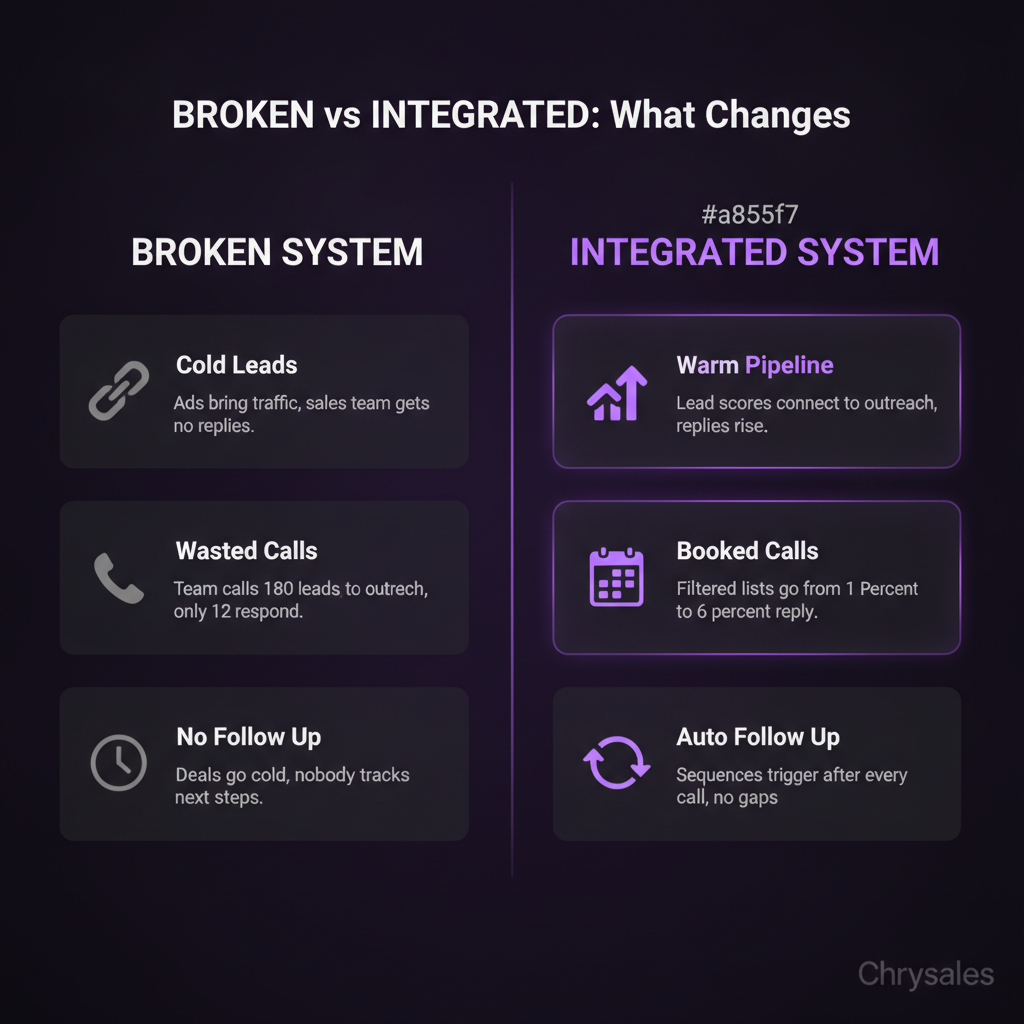
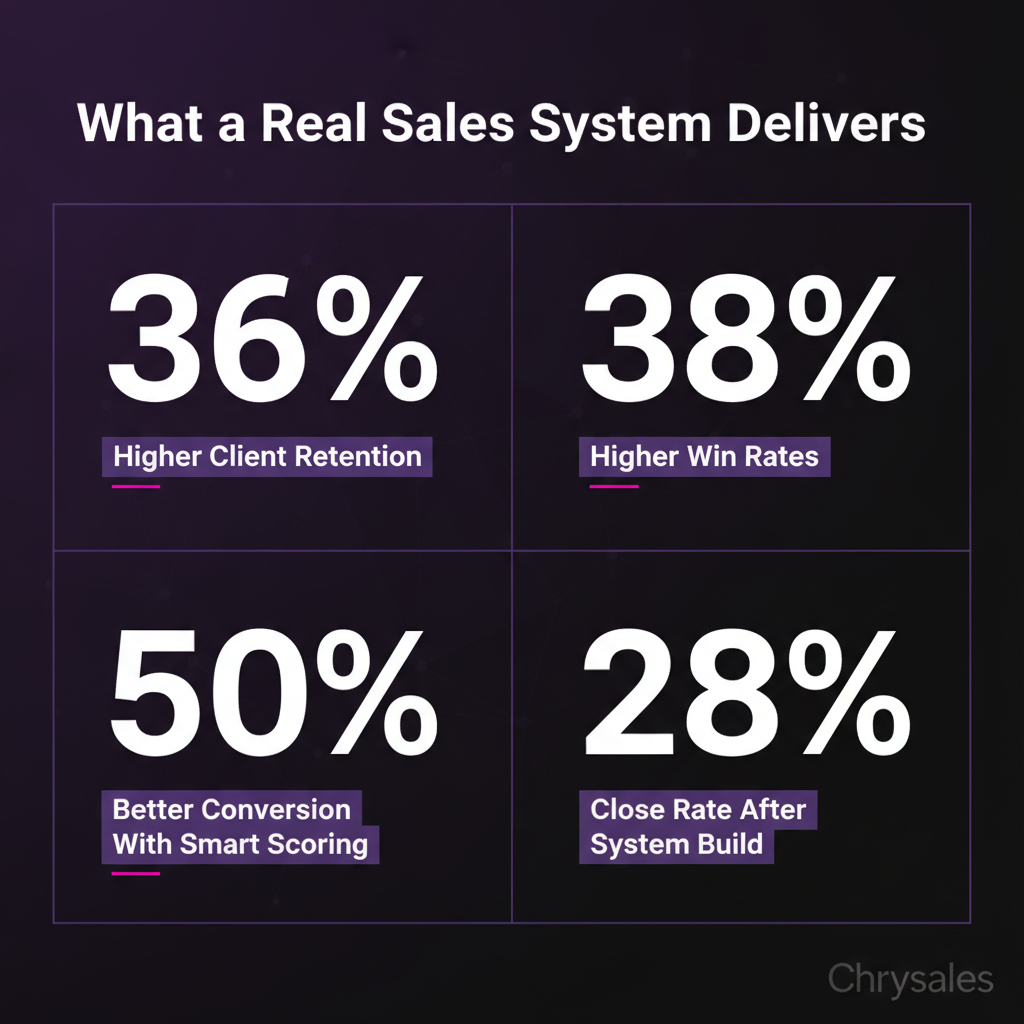
Here's what this looks like in practice: A 25 person tech company spends $8,000 a month on ads. They get 200 leads. Sales calls 180 of them. Only 12 answer. Three book meetings. One closes. That's a 0.5% conversion rate, and most teams think the problem is the salesperson or the ad creative. Neither. It's the gap between the two. According to research on sales and marketing alignment, companies with tightly integrated teams see 36% higher customer retention and 38% higher sales win rates.
Watch out: Most teams try to fix this by hiring more people or buying more software. That usually makes it worse, not better.
What Integrated Media Services Actually Means for B2B Sales
When people talk about integrated media services, they usually mean marketing agencies that run ads, SEO, social media, and content all under one roof. That's fine if you need more traffic. But traffic without a sales system is like filling a bucket with a hole in the bottom. The real opportunity for B2B growth isn't just coordinating your marketing channels. It's building an integrated sales system that connects lead generation, outreach, qualification, closing, and follow up into one predictable process. Think of it like a recipe. Every step depends on the one before it. Skip one, and the whole thing falls apart.
Full Funnel B2B Sales Strategy That Actually Works
Most integrated marketing agencies stop at the handoff. They deliver leads and walk away. But B2B sales doesn't work like that. A lead isn't a customer. It's just a name on a list. What matters is what happens next: the outreach message, the discovery call, the pitch, the objection handling, the close. That entire flow needs to be built, tested, and repeatable. Here's the thing nobody tells you: the system does most of the heavy lifting. A great salesperson with a broken system will struggle. An average salesperson with a great system will close deals. When you integrate your media services with your sales process, you stop relying on individual performance and start building something that scales.
Lead Generation That Actually Feeds Your Sales Pipeline
Most companies think lead generation is about volume. Get 500 names, email all of them, hope 10 respond. That's not lead generation. That's spam with extra steps. Good lead generation for B2B growth starts with the list. If your list is bad, nothing else matters. A 200 person company that just did layoffs is not a hot lead. It's a bad fit, full stop. You want companies that are growing, hiring, raising money, or launching new products. Those are key buying signals that indicate readiness to invest.
B2B Lead Generation That Connects to Closing Deals
The mistake most teams make is building their lead list in one tool, writing their outreach in another, tracking responses in a third, and managing their pipeline somewhere else. By the time a lead responds, nobody remembers what you even sent them. An integrated approach means your lead scoring connects to your outreach. Your outreach connects to your CRM. Your CRM connects to your sales call structure. Everything flows. When a lead replies, your sales team already knows their company size, their pain points, and exactly which offer to pitch. No fumbling. No "let me get back to you on that."
Pro Tip: Set a simple rule: anything scoring above 70 goes to the top of your call list. Anything below 50 gets a different message or waits. A marketing agency improved their lead quality by filtering their list before they even started outreach. They went from 500 cold contacts to 180 warm ones. Their reply rate jumped from 1.2% to 6%, and they booked 15 calls in two weeks. Same team, same offer, better system.
The Sales Training Nobody Talks About: Teaching Systems, Not Scripts
Most sales training teaches scripts. "Say this on the call. Handle objections like this." That's useful, but it's only 20% of the job. The other 80% is the system around the call: how leads get qualified before they even hop on, what information you gather during discovery, how you position the offer, what happens after the call ends. This is where integrated media services for business growth miss the mark. Marketing can bring in leads all day, but if your team doesn't know how to close them, you're just burning budget. Sales training needs to cover the full process: lead research, call prep, discovery questions, pitch structure, objection handling, follow up sequences, and how to spot when a deal is dead so you stop wasting time.
Client Acquisition Through Repeatable Sales Processes
We worked with a tech company who hired three salespeople in a month. Two quit within 60 days. The problem wasn't the hires. It was the lack of structure. They threw new people into calls with zero training, no scripts, no playbook. Of course they failed. After building a custom sales process with discovery question templates, pitch decks, and objection scripts, the next hire closed four deals in their first 90 days. Same company, same offer, same target market. Different system. Here's what a repeatable sales process looks like in practice:
- Lead comes in with a score and notes already attached
- Salesperson reviews their profile in under two minutes
- Call follows a structured discovery framework (not a rigid script, but a flow)
- Objections have pre built responses based on past wins
- Follow up is automatic: sequences trigger based on the outcome of the call
Common mistake: Most teams think "repeatable" means robotic. It doesn't. It means everyone on the team knows the next step, every time, no matter what.
Predictable Client Acquisition Comes From Systems, Not Luck
Most B2B companies run their sales like a roulette wheel. Some months are great. Some are terrible. Nobody knows why. That's not a business, that's a gamble. Predictable client acquisition means you can look at your pipeline on a Monday and forecast how many deals will close by Friday. Not perfectly, but close enough to plan. That only happens when every part of your process is tracked, measured, and repeatable. If you're struggling to break through plateaus, watch why most founders are stuck at $10k/month and how to fix it today for a practical breakdown of the system issues holding back growth.
Custom Sales Process for Growing B2B Companies
The difference between a $300K company and a $3M company isn't talent. It's systems. Small teams rely on the founder or one rock star salesperson to close everything. That works until it doesn't. If that person gets sick, takes a vacation, or quits, revenue drops to zero. An integrated B2B sales system spreads the load. Lead gen runs on its own. Outreach is templated and tested. Calls follow a structure. Follow up is automatic. When you hire someone new, they plug into the system and start producing in weeks, not months. A 30 person consulting firm tried this last quarter. They built a simple scoring system for leads, set up sequences for follow up, and trained their two salespeople on the same discovery framework. They went from 6 calls booked per month to 18, and their close rate jumped from 15% to 28%. Same market, same offer, better system.
Sales Coaching vs. DIY: When to Build It Yourself and When to Get Help
Look, you can build a sales system on your own. There are books, YouTube videos, free templates. But here's the truth: most teams spend six months trying to figure it out, get frustrated, and go back to winging it. Good sales coaching doesn't just give you a template and wish you luck. It builds a custom process for your business, your market, your offer. It trains your team on how to use it. It tracks what's working and fixes what's not. Over 1,000 business owners and 500+ sales teams have gone through structured coaching, and the ones who commit to the process see results in weeks, not years.
Sales Consulting for Agencies and B2B Teams
The agencies and B2B companies that grow fastest treat sales like marketing: something you test, measure, and improve every week. They don't leave it up to chance. They track reply rates, call to close ratios, objection patterns, and deal velocity. When something breaks, they fix it fast. Sales consulting helps you skip the trial and error phase. Instead of guessing what works, you get a system based on what's already working for similar companies. You get frameworks, templates, and live coaching. Most importantly, you get accountability. It's easy to let a project slide when it's just you and your team. It's harder when someone's checking in every week asking, "Did you hit your numbers?"
Pro Tip: If your close rate is under 20%, the problem is usually your discovery questions or your offer positioning, not your sales skills.
Sales Automation and AI: The Secret Weapon Most Teams Ignore
Most B2B companies are still doing sales like it's 2015. Manual list building. Copy pasting outreach emails. Tracking everything in spreadsheets. That works for 10 leads a month. It breaks at 100. Sales automation doesn't mean sending 1,000 robotic emails and hoping for the best. It means automating the repetitive stuff so your team can focus on the high value work: actual conversations, discovery, closing. Tools exist now that can score leads, write first drafts of outreach, book meetings, and update your CRM without a human touching anything.
AI in Sales: Beyond the Hype
AI gets a bad rep because most people use it wrong. They use ChatGPT to write a cold email, send it to 500 people, and wonder why nobody replies. That's not AI, that's lazy. Real AI in sales looks like this: AI tools analyze your best customers and find 200 more companies that look exactly like them. AI scores each lead based on hiring activity, funding news, and tech stack. AI drafts personalized outreach for each segment. Your sales team reviews it, tweaks it, and sends. The AI handles research and first drafts. Humans handle strategy and closing. One marketing agency integrated Gemini based workflows into their sales process. The AI handled lead research and email drafting. Their team went from spending 10 hours a week on admin work to 2 hours. They reinvested that time into more calls and closed 40% more deals that quarter. To implement the only AI sales system you need in 2026, focus on automating research and scoring while keeping humans in charge of relationship building.
The key is using AI to support your system, not replace it. The system is still king. AI just makes it faster. According to recent research on AI-powered lead scoring, companies using AI to prioritize leads see 50% higher conversion rates and 30% shorter sales cycles compared to manual qualification methods.
How Chrysales Builds Integrated Sales Systems for B2B Growth
Most agencies sell you marketing. Some sell you software. A few sell you training. Almost none build you a complete sales system and teach your team how to run it. Chrysales works with B2B companies, consulting firms, IT teams, and marketing agencies to build custom sales systems from scratch. Not a course you watch and forget. Not a SaaS tool you never use. A 1 on 1 process that builds your lead gen, your outreach, your call structure, your hiring process, and your automation into one predictable machine. The approach follows four steps: Learn what's broken, Build the systems that fix it, Automate the repetitive parts, and Hire a Chief of Staff to run it all when you're ready to scale. Over 12 years and 500+ sales teams trained, the model works. Clients have generated over €10M in revenue using these systems, with a 99.4% satisfaction rate.
Three Core Services That Actually Move the Needle
The focus is split into three areas:
Lead Generation: Building targeted lists, scoring leads, and setting up outbound systems that book calls without burning your reputation.
Closing Deals: Structuring discovery calls, building no brainer offers, training your team on objection handling, and creating pitch decks that convert. You can also watch how to build a sales system so powerful clients come to you to see the full framework in action.
Hiring & Scaling: Finding, training, and managing elite setters and closers so you're not stuck doing all the sales yourself.
Past clients include Amazon, Vodafone, Deutsche Börse, and Cloudification, but the process works just as well for a 15 person team as it does for a 500 person company. The system scales because it's built on fundamentals, not hacks.
Watch out: If someone promises you 50 booked calls in 30 days without asking about your offer, your market, or your close rate, run. Good sales systems take 4 to 8 weeks to build, and another 4 to 8 weeks to see consistent results.
Frequently Asked Questions
Q: What makes an integrated sales system different from just hiring a salesperson?
A salesperson is only as good as the system around them. If you hand someone a bad lead list, no script, and no training, even a great closer will struggle. An integrated sales system gives them the tools to succeed: qualified leads, proven messaging, call structures, and automation that handles follow up. You're not relying on one person's talent. You're building a process anyone can plug into and produce results.
Q: How long does it take to see results from a new sales system?
Most teams see improvement in 4 to 6 weeks once the system is live. The first 2 to 4 weeks are building: list creation, messaging tests, call structure, and training. After that, you start seeing more booked calls, better qualification, and higher close rates. Full optimization usually takes 8 to 12 weeks as you tweak what's working and drop what's not. It's faster than most marketing campaigns and way more predictable.
Q: Can small teams really use sales automation, or is it only for big companies?
Small teams benefit the most from automation because they have the least time to waste. You don't need a huge budget or a dedicated ops person. Simple automation like lead scoring, email sequences, and CRM updates can save 10+ hours a week. That's time you can spend on actual sales calls instead of admin work. Start small: automate one or two repetitive tasks, then add more as you grow.
Q: What's the biggest mistake B2B companies make with lead generation?
They focus on volume instead of quality. Sending 1,000 cold emails to a bad list gets you nowhere. A tight list of 150 companies that actually match your ideal customer profile will outperform every time. The second biggest mistake is not scoring leads. If you treat every lead the same, you waste time on people who were never going to buy. Score them based on fit, intent, and timing, then focus your energy on the top 20%.
Q: How do I know if I need sales coaching or if I can figure it out myself?
If you've been trying to fix your sales process for more than three months and you're still not seeing consistent results, you probably need help. DIY works if you have time to test, fail, and iterate. But most teams don't. Sales coaching speeds up the process by giving you a proven system, live feedback, and accountability. If your close rate is under 20%, your pipeline is unpredictable, or you're stuck doing all the selling yourself, coaching will pay for itself in the first few deals.
Best integrated media services business growth means connecting marketing, lead generation, B2B sales, and sales training into one system that helps you get more client acquisition and better GTM results. Picture this: You've got a marketing team running ads, a sales team making calls, and a content person posting on LinkedIn. All three are working hard, but nothing connects. Your ads bring traffic that never converts. Your sales team chases leads that went cold weeks ago. Your content gets likes but zero booked calls. Sound familiar? That's what happens when your growth systems don't talk to each other. The best integrated media services business growth fix this by building one system where everything works together, but most companies are looking in the wrong place.
Why Most Growth Strategies Fall Apart at the Seams
Most B2B companies treat marketing and sales like two different departments living in separate buildings. Marketing generates leads, dumps them in a spreadsheet, and calls it a day. Sales picks through the list, complains half the contacts are bad, and the cycle repeats. Nobody wins. The real problem isn't that either team is bad at their job. It's that there's no system connecting the work. Your marketing might be great at getting attention, but if your sales process can't close, you're just spending money on awareness. Your sales team might be incredible closers, but if the leads coming in are cold or unqualified, they're fighting an uphill battle.
The Hidden Cost of Disconnected Systems
Here's what this looks like in practice: A 25 person tech company spends $8,000 a month on ads. They get 200 leads. Sales calls 180 of them. Only 12 answer. Three book meetings. One closes. That's a 0.5% conversion rate, and most teams think the problem is the salesperson or the ad creative. Neither. It's the gap between the two. According to research on sales and marketing alignment, companies with tightly integrated teams see 36% higher customer retention and 38% higher sales win rates.
Watch out: Most teams try to fix this by hiring more people or buying more software. That usually makes it worse, not better.
What Integrated Media Services Actually Means for B2B Sales
When people talk about integrated media services, they usually mean marketing agencies that run ads, SEO, social media, and content all under one roof. That's fine if you need more traffic. But traffic without a sales system is like filling a bucket with a hole in the bottom. The real opportunity for B2B growth isn't just coordinating your marketing channels. It's building an integrated sales system that connects lead generation, outreach, qualification, closing, and follow up into one predictable process. Think of it like a recipe. Every step depends on the one before it. Skip one, and the whole thing falls apart.
Full Funnel B2B Sales Strategy That Actually Works
Most integrated marketing agencies stop at the handoff. They deliver leads and walk away. But B2B sales doesn't work like that. A lead isn't a customer. It's just a name on a list. What matters is what happens next: the outreach message, the discovery call, the pitch, the objection handling, the close. That entire flow needs to be built, tested, and repeatable. Here's the thing nobody tells you: the system does most of the heavy lifting. A great salesperson with a broken system will struggle. An average salesperson with a great system will close deals. When you integrate your media services with your sales process, you stop relying on individual performance and start building something that scales.
Lead Generation That Actually Feeds Your Sales Pipeline
Most companies think lead generation is about volume. Get 500 names, email all of them, hope 10 respond. That's not lead generation. That's spam with extra steps. Good lead generation for B2B growth starts with the list. If your list is bad, nothing else matters. A 200 person company that just did layoffs is not a hot lead. It's a bad fit, full stop. You want companies that are growing, hiring, raising money, or launching new products. Those are key buying signals that indicate readiness to invest.
B2B Lead Generation That Connects to Closing Deals
The mistake most teams make is building their lead list in one tool, writing their outreach in another, tracking responses in a third, and managing their pipeline somewhere else. By the time a lead responds, nobody remembers what you even sent them. An integrated approach means your lead scoring connects to your outreach. Your outreach connects to your CRM. Your CRM connects to your sales call structure. Everything flows. When a lead replies, your sales team already knows their company size, their pain points, and exactly which offer to pitch. No fumbling. No "let me get back to you on that."
Pro Tip: Set a simple rule: anything scoring above 70 goes to the top of your call list. Anything below 50 gets a different message or waits. A marketing agency improved their lead quality by filtering their list before they even started outreach. They went from 500 cold contacts to 180 warm ones. Their reply rate jumped from 1.2% to 6%, and they booked 15 calls in two weeks. Same team, same offer, better system.
The Sales Training Nobody Talks About: Teaching Systems, Not Scripts
Most sales training teaches scripts. "Say this on the call. Handle objections like this." That's useful, but it's only 20% of the job. The other 80% is the system around the call: how leads get qualified before they even hop on, what information you gather during discovery, how you position the offer, what happens after the call ends. This is where integrated media services for business growth miss the mark. Marketing can bring in leads all day, but if your team doesn't know how to close them, you're just burning budget. Sales training needs to cover the full process: lead research, call prep, discovery questions, pitch structure, objection handling, follow up sequences, and how to spot when a deal is dead so you stop wasting time.
Client Acquisition Through Repeatable Sales Processes
We worked with a tech company who hired three salespeople in a month. Two quit within 60 days. The problem wasn't the hires. It was the lack of structure. They threw new people into calls with zero training, no scripts, no playbook. Of course they failed. After building a custom sales process with discovery question templates, pitch decks, and objection scripts, the next hire closed four deals in their first 90 days. Same company, same offer, same target market. Different system. Here's what a repeatable sales process looks like in practice:
- Lead comes in with a score and notes already attached
- Salesperson reviews their profile in under two minutes
- Call follows a structured discovery framework (not a rigid script, but a flow)
- Objections have pre built responses based on past wins
- Follow up is automatic: sequences trigger based on the outcome of the call
Common mistake: Most teams think "repeatable" means robotic. It doesn't. It means everyone on the team knows the next step, every time, no matter what.
Predictable Client Acquisition Comes From Systems, Not Luck
Most B2B companies run their sales like a roulette wheel. Some months are great. Some are terrible. Nobody knows why. That's not a business, that's a gamble. Predictable client acquisition means you can look at your pipeline on a Monday and forecast how many deals will close by Friday. Not perfectly, but close enough to plan. That only happens when every part of your process is tracked, measured, and repeatable. If you're struggling to break through plateaus, watch why most founders are stuck at $10k/month and how to fix it today for a practical breakdown of the system issues holding back growth.
Custom Sales Process for Growing B2B Companies
The difference between a $300K company and a $3M company isn't talent. It's systems. Small teams rely on the founder or one rock star salesperson to close everything. That works until it doesn't. If that person gets sick, takes a vacation, or quits, revenue drops to zero. An integrated B2B sales system spreads the load. Lead gen runs on its own. Outreach is templated and tested. Calls follow a structure. Follow up is automatic. When you hire someone new, they plug into the system and start producing in weeks, not months. A 30 person consulting firm tried this last quarter. They built a simple scoring system for leads, set up sequences for follow up, and trained their two salespeople on the same discovery framework. They went from 6 calls booked per month to 18, and their close rate jumped from 15% to 28%. Same market, same offer, better system.
Sales Coaching vs. DIY: When to Build It Yourself and When to Get Help
Look, you can build a sales system on your own. There are books, YouTube videos, free templates. But here's the truth: most teams spend six months trying to figure it out, get frustrated, and go back to winging it. Good sales coaching doesn't just give you a template and wish you luck. It builds a custom process for your business, your market, your offer. It trains your team on how to use it. It tracks what's working and fixes what's not. Over 1,000 business owners and 500+ sales teams have gone through structured coaching, and the ones who commit to the process see results in weeks, not years.
Sales Consulting for Agencies and B2B Teams
The agencies and B2B companies that grow fastest treat sales like marketing: something you test, measure, and improve every week. They don't leave it up to chance. They track reply rates, call to close ratios, objection patterns, and deal velocity. When something breaks, they fix it fast. Sales consulting helps you skip the trial and error phase. Instead of guessing what works, you get a system based on what's already working for similar companies. You get frameworks, templates, and live coaching. Most importantly, you get accountability. It's easy to let a project slide when it's just you and your team. It's harder when someone's checking in every week asking, "Did you hit your numbers?"
Pro Tip: If your close rate is under 20%, the problem is usually your discovery questions or your offer positioning, not your sales skills.
Sales Automation and AI: The Secret Weapon Most Teams Ignore
Most B2B companies are still doing sales like it's 2015. Manual list building. Copy pasting outreach emails. Tracking everything in spreadsheets. That works for 10 leads a month. It breaks at 100. Sales automation doesn't mean sending 1,000 robotic emails and hoping for the best. It means automating the repetitive stuff so your team can focus on the high value work: actual conversations, discovery, closing. Tools exist now that can score leads, write first drafts of outreach, book meetings, and update your CRM without a human touching anything.
AI in Sales: Beyond the Hype
AI gets a bad rep because most people use it wrong. They use ChatGPT to write a cold email, send it to 500 people, and wonder why nobody replies. That's not AI, that's lazy. Real AI in sales looks like this: AI tools analyze your best customers and find 200 more companies that look exactly like them. AI scores each lead based on hiring activity, funding news, and tech stack. AI drafts personalized outreach for each segment. Your sales team reviews it, tweaks it, and sends. The AI handles research and first drafts. Humans handle strategy and closing. One marketing agency integrated Gemini based workflows into their sales process. The AI handled lead research and email drafting. Their team went from spending 10 hours a week on admin work to 2 hours. They reinvested that time into more calls and closed 40% more deals that quarter. To implement the only AI sales system you need in 2026, focus on automating research and scoring while keeping humans in charge of relationship building.
The key is using AI to support your system, not replace it. The system is still king. AI just makes it faster. According to recent research on AI-powered lead scoring, companies using AI to prioritize leads see 50% higher conversion rates and 30% shorter sales cycles compared to manual qualification methods.
How Chrysales Builds Integrated Sales Systems for B2B Growth
Most agencies sell you marketing. Some sell you software. A few sell you training. Almost none build you a complete sales system and teach your team how to run it. Chrysales works with B2B companies, consulting firms, IT teams, and marketing agencies to build custom sales systems from scratch. Not a course you watch and forget. Not a SaaS tool you never use. A 1 on 1 process that builds your lead gen, your outreach, your call structure, your hiring process, and your automation into one predictable machine. The approach follows four steps: Learn what's broken, Build the systems that fix it, Automate the repetitive parts, and Hire a Chief of Staff to run it all when you're ready to scale. Over 12 years and 500+ sales teams trained, the model works. Clients have generated over €10M in revenue using these systems, with a 99.4% satisfaction rate.
Three Core Services That Actually Move the Needle
The focus is split into three areas:
Lead Generation: Building targeted lists, scoring leads, and setting up outbound systems that book calls without burning your reputation.
Closing Deals: Structuring discovery calls, building no brainer offers, training your team on objection handling, and creating pitch decks that convert. You can also watch how to build a sales system so powerful clients come to you to see the full framework in action.
Hiring & Scaling: Finding, training, and managing elite setters and closers so you're not stuck doing all the sales yourself.
Past clients include Amazon, Vodafone, Deutsche Börse, and Cloudification, but the process works just as well for a 15 person team as it does for a 500 person company. The system scales because it's built on fundamentals, not hacks.
Watch out: If someone promises you 50 booked calls in 30 days without asking about your offer, your market, or your close rate, run. Good sales systems take 4 to 8 weeks to build, and another 4 to 8 weeks to see consistent results.
Frequently Asked Questions
Q: What makes an integrated sales system different from just hiring a salesperson?
A salesperson is only as good as the system around them. If you hand someone a bad lead list, no script, and no training, even a great closer will struggle. An integrated sales system gives them the tools to succeed: qualified leads, proven messaging, call structures, and automation that handles follow up. You're not relying on one person's talent. You're building a process anyone can plug into and produce results.
Q: How long does it take to see results from a new sales system?
Most teams see improvement in 4 to 6 weeks once the system is live. The first 2 to 4 weeks are building: list creation, messaging tests, call structure, and training. After that, you start seeing more booked calls, better qualification, and higher close rates. Full optimization usually takes 8 to 12 weeks as you tweak what's working and drop what's not. It's faster than most marketing campaigns and way more predictable.
Q: Can small teams really use sales automation, or is it only for big companies?
Small teams benefit the most from automation because they have the least time to waste. You don't need a huge budget or a dedicated ops person. Simple automation like lead scoring, email sequences, and CRM updates can save 10+ hours a week. That's time you can spend on actual sales calls instead of admin work. Start small: automate one or two repetitive tasks, then add more as you grow.
Q: What's the biggest mistake B2B companies make with lead generation?
They focus on volume instead of quality. Sending 1,000 cold emails to a bad list gets you nowhere. A tight list of 150 companies that actually match your ideal customer profile will outperform every time. The second biggest mistake is not scoring leads. If you treat every lead the same, you waste time on people who were never going to buy. Score them based on fit, intent, and timing, then focus your energy on the top 20%.
Q: How do I know if I need sales coaching or if I can figure it out myself?
If you've been trying to fix your sales process for more than three months and you're still not seeing consistent results, you probably need help. DIY works if you have time to test, fail, and iterate. But most teams don't. Sales coaching speeds up the process by giving you a proven system, live feedback, and accountability. If your close rate is under 20%, your pipeline is unpredictable, or you're stuck doing all the selling yourself, coaching will pay for itself in the first few deals.
Scaling Is Not Hard If You Have The Right Systems
If you’re serious about leveling up your scaling game, you need the right system, the right training, and the right team behind you. We're here to give you the exact tools and strategies top entrepreneurs use to dominate.

Discover the latest tips
View All.avif)
Chrysales was formed from the words "chrysalis" the stage where a caterpillar transforms into a butterfly and "sales".
It stands for one thing: sales transformation.Because scaling doesn’t happen by doing more of the same. Scaling only happens when you go through real transformation in your systems, your offer, team and the way you sell.
.avif)


