.avif)
How to Use AI Sales Enablement to Close More Deals
AI sales enablement is using smart software to coach sales teams, organize content, and close deals faster without hiring more people. It builds a system that makes reps smarter and consistent without you babysitting every call. Most sales teams treat AI like a shiny toy. They buy a tool, let it sit there, and wonder why nothing changes. Here's the thing: AI sales enablement isn't about the tool. It's about building a system that makes your reps smarter, faster, and more consistent without you babysitting every call. Think of it like giving your team a GPS instead of a paper map. They still drive, but they get there faster and make fewer wrong turns. Let's break down how to actually use AI to coach better, create content that works, and close deals predictably.
What AI Sales Enablement Actually Means (And What It Doesn't)
AI sales enablement is using smart software to help your sales team know what to say, when to say it, and how to follow up. It's not a magic button that closes deals for you. It's a system that supports reps with the right content, coaching feedback, and next steps at exactly the right moment. Most people think enablement is just throwing a bunch of PDFs and slide decks into a shared folder. That's not enablement. That's a digital filing cabinet. Real enablement means your reps get what they need, when they need it, without hunting through 47 folders or asking you the same question twice.
The Old Way vs. The New Way
The old way looked like this: you train someone once, they forget half of it, they wing their calls, and you find out three months later they've been pitching the wrong thing. By then, you've lost deals and wasted time. The new way uses AI to analyze every call, surface the right talking points before meetings, and suggest follow-up messages based on what the buyer actually said. It's like having a sales coach sitting next to every rep, all day, without paying for 12 coaches.
Pro Tip: If your team spends more than 10 minutes searching for a case study or pricing sheet, your enablement system is broken.
Why This Matters for B2B Sales
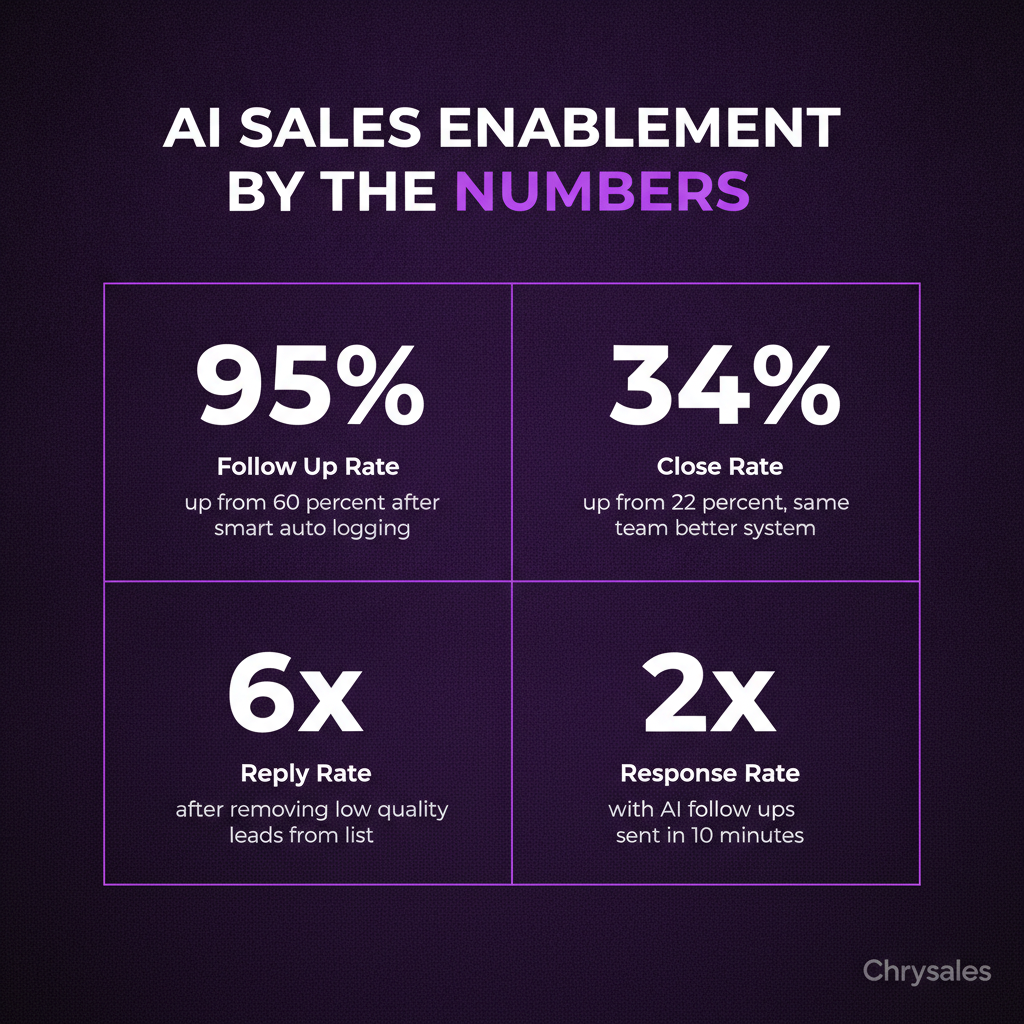
B2B sales cycles are long. Buyers talk to multiple people. Reps need to remember details from three calls ago and tailor every message. AI sales enablement tools track all of that automatically. They flag when a deal is going cold, remind reps to follow up, and even score how good their pitch was based on winning patterns from past deals. A 15-person consulting firm we worked with had reps manually logging notes after every call. Half the notes were incomplete. AI conversation intelligence started auto-logging everything and pulling out action items. Their follow-up rate jumped from 60% to 95% in two weeks.
How AI Fixes the Three Biggest Sales Coaching Problems
Sales coaching is hard to scale. You can't sit on every call. You can't give real-time feedback when someone's pitch goes sideways. And honestly, most managers don't have time to review recordings for hours every week. AI sales coaching solves all three.
Problem 1: You Don't Know What's Happening on Calls Until It's Too Late
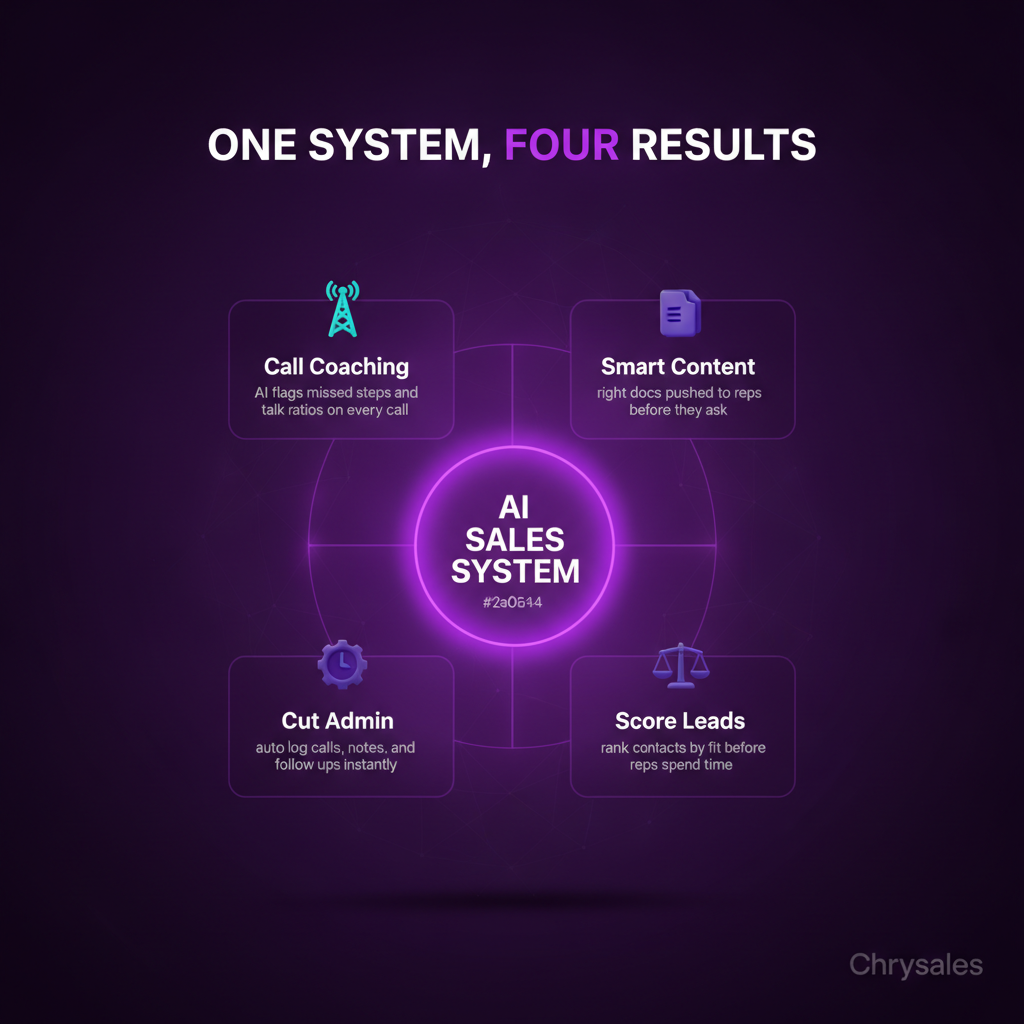
Most reps won't tell you when a call goes badly. You find out when the deal dies. AI conversation intelligence listens to every call and flags the moments that matter. Did the rep miss an objection? Did they forget to ask about budget? Did they talk for 80% of the call instead of listening? You get a dashboard that shows you exactly where each person is struggling. No guesswork. No waiting for the rep to admit they need help.
Problem 2: Coaching Feels Like Guessing
Without data, coaching is just opinions. "I think you should sound more confident." Cool, but what does that mean? AI gives you the numbers. It tracks talk-to-listen ratios, question counts, how fast reps respond to objections, and which phrases correlate with closed deals. One marketing agency had a closer who kept losing deals at the pricing stage. AI flagged that he was introducing price 12 minutes into a 20-minute call, way too early. Once he moved it to minute 18 and anchored value first, his close rate went from 18% to 31%.
Watch out: AI can tell you what's wrong, but it can't fix the person. You still need to coach. The difference is now you know exactly what to coach on.
Problem 3: New Reps Take Forever to Ramp
Training someone new takes months. They listen to a few calls, shadow someone, then fumble through their first 20 dials. AI cuts that time in half. New reps can search a library of top-performing calls, see exactly how the best closers handle objections, and get real-time prompts during their own calls. Sales training used to be "listen to Bob's best call from last year." Now it's "here are the 14 calls where we closed deals over $50k, sorted by objection type, with AI summaries of what worked."
Building a Content System That Actually Gets Used
Here's a dirty secret: most sales content never gets used. Reps don't know it exists, can't find it, or don't trust that it's current. AI sales enablement tools fix this by making content searchable, smart, and contextual.
Make Everything Searchable in Plain English
Your reps should be able to type "case study for SaaS company with compliance needs" and get the right PDF in three seconds. Not dig through folders labeled "Q3 2023 Assets" and "Final Final v2." Sales enablement automation tools use AI to tag and organize everything. They index the actual content inside decks and docs, so search actually works. This sounds basic, but most teams don't have it.
Push Content to Reps Before They Need It
AI tools can watch your CRM and suggest content based on deal stage. If a rep just moved a deal to "proposal sent," the system can auto-suggest a follow-up email template and a one-pager that addresses common concerns at that stage. A tech company we worked with had 40 different one-pagers. Reps used maybe five of them because they didn't know the others existed. After setting up AI-driven content recommendations, usage of the full library went up 4x in a month.
Let AI Generate First Drafts
AI can write personalized email follow-ups based on call transcripts. It can pull together a custom proposal using your templates and the buyer's specific pain points. It can even create LinkedIn messages that reference something the buyer mentioned on the call. You still edit and approve. But starting from a solid first draft instead of a blank page saves 20 minutes per follow-up. Over a week, that's hours back.
Common mistake: Giving reps access to 100 pieces of content with no guidance on which to use when. That's not enablement, it's clutter.
Using AI to Score Leads and Prioritize Outreach
Not all leads are equal. A 200-person company that just did layoffs is not a "hot lead." It's a bad fit, full stop. AI lead scoring helps you figure out which contacts are actually worth calling first.
How Lead Scoring Works Without the Complexity
AI looks at signals like company size, recent funding, tech stack, hiring patterns, job changes, and engagement with your content. It scores every lead on a scale, say 0 to 100. Anything above 70 goes to the top of your list. You don't need a data scientist to set this up. Most B2B sales enablement platforms have scoring built in. You just tell the system what a good fit looks like, and it learns from which leads close.
Stop Wasting Time on Cold Contacts
Picture this: you spend two weeks writing perfect cold emails, but your list is full of people who aren't even buyers. That's the trap. AI enrichment tools pull in job titles, company data, and intent signals so you're only reaching out to people who actually fit your ideal customer profile. One consulting firm cut their list from 1,000 contacts to 320 after AI scoring flagged the low-quality ones. Their reply rate jumped from 2% to 6% because they stopped emailing the wrong people.
Real-Time Notifications for High-Intent Moments
AI can alert your team when a lead visits your pricing page three times, downloads a case study, or gets promoted to a decision-making role. These are buying signals. If your rep reaches out within an hour, they're 10x more likely to book a meeting than if they wait two days.
Pro Tip: Set a simple rule in your system. Anything scoring above 70 goes to your best closer. Anything 50 to 70 goes to your setters. Under 50 gets nurtured with automated emails.
Automating Repetitive Sales Tasks So Reps Can Actually Sell
Reps spend less than 35% of their time selling. The rest is admin: logging calls, writing follow-ups, updating the CRM, scheduling meetings. Sales enablement automation takes that stuff off their plate.
Auto-Logging Everything
AI tools can listen to calls, pull out key details, and write the CRM notes for you. They log the meeting, tag the deal stage, and set follow-up reminders. Your rep just has the conversation. This isn't about being lazy. It's about removing friction. When logging a call takes two minutes, reps skip it. When it happens automatically, your CRM is always current.
Automated Follow-Ups That Feel Personal
AI can send a follow-up email 30 minutes after a call, referencing specific things the buyer mentioned. It sounds personal because it is. The AI pulled the details from the transcript. A marketing agency tested this with their SDRs. Manual follow-ups took an average of 4 hours to send (because reps got busy). AI-generated follow-ups went out in 10 minutes. Response rates doubled.
Meeting Scheduling Without the Back-and-Forth
No more "Does Thursday at 2pm work? Actually, can we do 3pm?" AI scheduling tools look at your calendar and the buyer's availability, suggest three times, and book it. One click, done. Sounds small. But when you're juggling 30 deals, it saves an hour a day.
How to Actually Implement AI Sales Enablement Without Losing Your Mind
Most teams buy a tool, get overwhelmed, and give up in two months. The problem isn't the tool. It's trying to do everything at once. Start small. Pick one thing to fix first.
Step 1: Pick Your Biggest Pain Point
Are reps forgetting to follow up? Start with conversation intelligence and automated reminders. Is your content a mess? Start with a searchable content library. Are leads going cold because no one knows who to call first? Start with lead scoring. Don't try to roll out five AI tools in one week. Pick one. Get it working. Then add the next.
Step 2: Train Your Team on the "Why," Not Just the "How"
Reps resist new tools when they don't see the point. Show them what's in it for them. "This tool writes your follow-up emails so you can spend time on calls instead." That's a reason to care. Walk them through three real examples from your own pipeline. Show them how it works with deals they recognize.
Step 3: Build Feedback Loops
AI gets better when you tell it what works. If a lead scored at 80 turned out to be a bad fit, mark it. If an email template bombed, flag it. The system learns. Set a simple rule: every Friday, review what the AI suggested that week. Keep what worked, tweak what didn't. This takes 15 minutes and makes the system smarter every month.
Watch out: Most teams set up AI tools and then ignore them. You have to actively manage the system for the first 60 days or it won't stick.
Connecting AI Sales Enablement to Predictable Revenue
All of this AI stuff only matters if it moves the number. Predictable revenue means you know how many leads you need to hit your sales target, and you have a system that delivers it every month. AI sales enablement is part of that system.
How It Ties to Lead Generation
AI helps you build better lists, score leads smarter, and personalize outreach at scale. That means more replies, more meetings, and more deals in your pipeline. Better lead generation is the front door to predictable client acquisition. If you're building this from scratch, how to build a sales system that actually scales will show you the foundation to layer AI on top of.
How It Ties to Closing Deals
AI coaching helps reps get better faster. AI content delivery gives them exactly what they need in the moment. AI follow-ups keep deals moving. All of that adds up to higher close rates and shorter sales cycles. A 20-person IT consulting firm we worked with had a 22% close rate before implementing AI conversation intelligence and automated follow-ups. Six months later, they were at 34%. Same team. Better system.
How It Ties to Scaling
You can't scale by hiring more people if your system is broken. AI lets you do more with the team you have. When each rep is 30% more productive because AI handles the busywork, you can grow revenue without doubling headcount. Once your enablement foundations are in place, you can layer on the best AI SDR tools in 2025 to scale outreach without hiring a bigger team.
Pro Tip: Track three numbers: reply rate, meeting-to-close rate, and time to close. If AI enablement is working, all three should improve within 90 days.
Common Mistakes Teams Make With AI Sales Enablement Tools
We see new clients make the same three mistakes over and over. Avoid these and you'll save yourself months of frustration.
Mistake 1: Buying Tools Before Fixing the Process
AI can't fix a bad process. If your sales pitch is unclear, if your offer is confusing, if your reps don't know who they're calling, no tool will save you. Fix the foundation first. Then add AI to make it faster. To see a live example of many of these ideas, AI coaching, content surfacing, lead scoring, and automated follow-up, watch AI sales system get you record revenue and see how it fits together in one workflow.
Mistake 2: Not Integrating Tools With Your CRM
If your AI tools don't talk to your CRM, you end up with data in three places and nobody knows what's real. Spend the extra two days setting up integrations. It's worth it.
Mistake 3: Expecting AI to Replace Coaching
AI tells you what to coach. It doesn't do the coaching for you. You still need to sit with your reps, role-play objections, and give feedback. AI just makes that coaching 10x more targeted. For teams ready to go deeper into tooling, the only AI sales system you need in 2026 walks through designing the complete stack, from lead scoring to follow-up automation.
Frequently Asked Questions
Q: Do I need a big sales team to use AI sales enablement?
No. AI works for teams of three just as well as teams of 30. In fact, small teams benefit more because AI lets you do things that used to require a full sales ops person. You get the productivity boost without the extra hire.
Q: How long does it take to see results from AI sales enablement?
Most teams see improvements in 30 to 60 days. Things like automated follow-ups and lead scoring can show results in the first two weeks. Coaching improvements take a bit longer because reps need time to change habits. Don't expect magic overnight, but don't wait six months either.
Q: What's the difference between sales enablement tools and a CRM?
Your CRM tracks deals and contacts. Sales enablement tools help reps actually sell. They provide content, coaching, automation, and insights that sit on top of your CRM. Think of the CRM as the database and enablement tools as the system that makes your team better at using that database.
Q: Can AI really write follow-up emails that sound human?
Yes, if you set it up right. AI pulls details from your call transcripts and writes personalized messages. You should still review and edit them, especially at first. Over time, the AI learns your tone and gets better. Most buyers can't tell the difference between a good AI-drafted email and one you wrote yourself.
Q: Do I need a tech background to implement AI sales enablement?
Not at all. Most modern tools are built for non-technical users. You don't need to code or understand machine learning. You just need to connect the tool to your CRM, set a few preferences, and train your team to use it. If you can set up a Zoom meeting, you can set up AI sales enablement.
Q: How much does AI sales enablement cost?
It depends on the tools and team size. Most conversation intelligence and sales enablement automation platforms charge per user per month, usually between $50 and $200. For a small team, you're looking at a few hundred bucks a month. For larger teams, it scales up. The ROI usually shows up fast because reps close more deals and waste less time.
Q: Will AI take my sales team's jobs?
No. AI handles repetitive tasks so your reps can focus on the human parts of selling: building relationships, understanding complex needs, and closing deals. The best salespeople will use AI to get better and faster. The ones who refuse to adapt will struggle, but that's true of any tool. AI is a multiplier, not a replacement.
AI sales enablement is using smart software to coach sales teams, organize content, and close deals faster without hiring more people. It builds a system that makes reps smarter and consistent without you babysitting every call. Most sales teams treat AI like a shiny toy. They buy a tool, let it sit there, and wonder why nothing changes. Here's the thing: AI sales enablement isn't about the tool. It's about building a system that makes your reps smarter, faster, and more consistent without you babysitting every call. Think of it like giving your team a GPS instead of a paper map. They still drive, but they get there faster and make fewer wrong turns. Let's break down how to actually use AI to coach better, create content that works, and close deals predictably.
What AI Sales Enablement Actually Means (And What It Doesn't)
AI sales enablement is using smart software to help your sales team know what to say, when to say it, and how to follow up. It's not a magic button that closes deals for you. It's a system that supports reps with the right content, coaching feedback, and next steps at exactly the right moment. Most people think enablement is just throwing a bunch of PDFs and slide decks into a shared folder. That's not enablement. That's a digital filing cabinet. Real enablement means your reps get what they need, when they need it, without hunting through 47 folders or asking you the same question twice.
The Old Way vs. The New Way
The old way looked like this: you train someone once, they forget half of it, they wing their calls, and you find out three months later they've been pitching the wrong thing. By then, you've lost deals and wasted time. The new way uses AI to analyze every call, surface the right talking points before meetings, and suggest follow-up messages based on what the buyer actually said. It's like having a sales coach sitting next to every rep, all day, without paying for 12 coaches.
Pro Tip: If your team spends more than 10 minutes searching for a case study or pricing sheet, your enablement system is broken.
Why This Matters for B2B Sales
B2B sales cycles are long. Buyers talk to multiple people. Reps need to remember details from three calls ago and tailor every message. AI sales enablement tools track all of that automatically. They flag when a deal is going cold, remind reps to follow up, and even score how good their pitch was based on winning patterns from past deals. A 15-person consulting firm we worked with had reps manually logging notes after every call. Half the notes were incomplete. AI conversation intelligence started auto-logging everything and pulling out action items. Their follow-up rate jumped from 60% to 95% in two weeks.
How AI Fixes the Three Biggest Sales Coaching Problems
Sales coaching is hard to scale. You can't sit on every call. You can't give real-time feedback when someone's pitch goes sideways. And honestly, most managers don't have time to review recordings for hours every week. AI sales coaching solves all three.
Problem 1: You Don't Know What's Happening on Calls Until It's Too Late
Most reps won't tell you when a call goes badly. You find out when the deal dies. AI conversation intelligence listens to every call and flags the moments that matter. Did the rep miss an objection? Did they forget to ask about budget? Did they talk for 80% of the call instead of listening? You get a dashboard that shows you exactly where each person is struggling. No guesswork. No waiting for the rep to admit they need help.
Problem 2: Coaching Feels Like Guessing
Without data, coaching is just opinions. "I think you should sound more confident." Cool, but what does that mean? AI gives you the numbers. It tracks talk-to-listen ratios, question counts, how fast reps respond to objections, and which phrases correlate with closed deals. One marketing agency had a closer who kept losing deals at the pricing stage. AI flagged that he was introducing price 12 minutes into a 20-minute call, way too early. Once he moved it to minute 18 and anchored value first, his close rate went from 18% to 31%.
Watch out: AI can tell you what's wrong, but it can't fix the person. You still need to coach. The difference is now you know exactly what to coach on.
Problem 3: New Reps Take Forever to Ramp
Training someone new takes months. They listen to a few calls, shadow someone, then fumble through their first 20 dials. AI cuts that time in half. New reps can search a library of top-performing calls, see exactly how the best closers handle objections, and get real-time prompts during their own calls. Sales training used to be "listen to Bob's best call from last year." Now it's "here are the 14 calls where we closed deals over $50k, sorted by objection type, with AI summaries of what worked."
Building a Content System That Actually Gets Used
Here's a dirty secret: most sales content never gets used. Reps don't know it exists, can't find it, or don't trust that it's current. AI sales enablement tools fix this by making content searchable, smart, and contextual.
Make Everything Searchable in Plain English
Your reps should be able to type "case study for SaaS company with compliance needs" and get the right PDF in three seconds. Not dig through folders labeled "Q3 2023 Assets" and "Final Final v2." Sales enablement automation tools use AI to tag and organize everything. They index the actual content inside decks and docs, so search actually works. This sounds basic, but most teams don't have it.
Push Content to Reps Before They Need It
AI tools can watch your CRM and suggest content based on deal stage. If a rep just moved a deal to "proposal sent," the system can auto-suggest a follow-up email template and a one-pager that addresses common concerns at that stage. A tech company we worked with had 40 different one-pagers. Reps used maybe five of them because they didn't know the others existed. After setting up AI-driven content recommendations, usage of the full library went up 4x in a month.
Let AI Generate First Drafts
AI can write personalized email follow-ups based on call transcripts. It can pull together a custom proposal using your templates and the buyer's specific pain points. It can even create LinkedIn messages that reference something the buyer mentioned on the call. You still edit and approve. But starting from a solid first draft instead of a blank page saves 20 minutes per follow-up. Over a week, that's hours back.
Common mistake: Giving reps access to 100 pieces of content with no guidance on which to use when. That's not enablement, it's clutter.
Using AI to Score Leads and Prioritize Outreach
Not all leads are equal. A 200-person company that just did layoffs is not a "hot lead." It's a bad fit, full stop. AI lead scoring helps you figure out which contacts are actually worth calling first.
How Lead Scoring Works Without the Complexity
AI looks at signals like company size, recent funding, tech stack, hiring patterns, job changes, and engagement with your content. It scores every lead on a scale, say 0 to 100. Anything above 70 goes to the top of your list. You don't need a data scientist to set this up. Most B2B sales enablement platforms have scoring built in. You just tell the system what a good fit looks like, and it learns from which leads close.
Stop Wasting Time on Cold Contacts
Picture this: you spend two weeks writing perfect cold emails, but your list is full of people who aren't even buyers. That's the trap. AI enrichment tools pull in job titles, company data, and intent signals so you're only reaching out to people who actually fit your ideal customer profile. One consulting firm cut their list from 1,000 contacts to 320 after AI scoring flagged the low-quality ones. Their reply rate jumped from 2% to 6% because they stopped emailing the wrong people.
Real-Time Notifications for High-Intent Moments
AI can alert your team when a lead visits your pricing page three times, downloads a case study, or gets promoted to a decision-making role. These are buying signals. If your rep reaches out within an hour, they're 10x more likely to book a meeting than if they wait two days.
Pro Tip: Set a simple rule in your system. Anything scoring above 70 goes to your best closer. Anything 50 to 70 goes to your setters. Under 50 gets nurtured with automated emails.
Automating Repetitive Sales Tasks So Reps Can Actually Sell
Reps spend less than 35% of their time selling. The rest is admin: logging calls, writing follow-ups, updating the CRM, scheduling meetings. Sales enablement automation takes that stuff off their plate.
Auto-Logging Everything
AI tools can listen to calls, pull out key details, and write the CRM notes for you. They log the meeting, tag the deal stage, and set follow-up reminders. Your rep just has the conversation. This isn't about being lazy. It's about removing friction. When logging a call takes two minutes, reps skip it. When it happens automatically, your CRM is always current.
Automated Follow-Ups That Feel Personal
AI can send a follow-up email 30 minutes after a call, referencing specific things the buyer mentioned. It sounds personal because it is. The AI pulled the details from the transcript. A marketing agency tested this with their SDRs. Manual follow-ups took an average of 4 hours to send (because reps got busy). AI-generated follow-ups went out in 10 minutes. Response rates doubled.
Meeting Scheduling Without the Back-and-Forth
No more "Does Thursday at 2pm work? Actually, can we do 3pm?" AI scheduling tools look at your calendar and the buyer's availability, suggest three times, and book it. One click, done. Sounds small. But when you're juggling 30 deals, it saves an hour a day.
How to Actually Implement AI Sales Enablement Without Losing Your Mind
Most teams buy a tool, get overwhelmed, and give up in two months. The problem isn't the tool. It's trying to do everything at once. Start small. Pick one thing to fix first.
Step 1: Pick Your Biggest Pain Point
Are reps forgetting to follow up? Start with conversation intelligence and automated reminders. Is your content a mess? Start with a searchable content library. Are leads going cold because no one knows who to call first? Start with lead scoring. Don't try to roll out five AI tools in one week. Pick one. Get it working. Then add the next.
Step 2: Train Your Team on the "Why," Not Just the "How"
Reps resist new tools when they don't see the point. Show them what's in it for them. "This tool writes your follow-up emails so you can spend time on calls instead." That's a reason to care. Walk them through three real examples from your own pipeline. Show them how it works with deals they recognize.
Step 3: Build Feedback Loops
AI gets better when you tell it what works. If a lead scored at 80 turned out to be a bad fit, mark it. If an email template bombed, flag it. The system learns. Set a simple rule: every Friday, review what the AI suggested that week. Keep what worked, tweak what didn't. This takes 15 minutes and makes the system smarter every month.
Watch out: Most teams set up AI tools and then ignore them. You have to actively manage the system for the first 60 days or it won't stick.
Connecting AI Sales Enablement to Predictable Revenue
All of this AI stuff only matters if it moves the number. Predictable revenue means you know how many leads you need to hit your sales target, and you have a system that delivers it every month. AI sales enablement is part of that system.
How It Ties to Lead Generation
AI helps you build better lists, score leads smarter, and personalize outreach at scale. That means more replies, more meetings, and more deals in your pipeline. Better lead generation is the front door to predictable client acquisition. If you're building this from scratch, how to build a sales system that actually scales will show you the foundation to layer AI on top of.
How It Ties to Closing Deals
AI coaching helps reps get better faster. AI content delivery gives them exactly what they need in the moment. AI follow-ups keep deals moving. All of that adds up to higher close rates and shorter sales cycles. A 20-person IT consulting firm we worked with had a 22% close rate before implementing AI conversation intelligence and automated follow-ups. Six months later, they were at 34%. Same team. Better system.
How It Ties to Scaling
You can't scale by hiring more people if your system is broken. AI lets you do more with the team you have. When each rep is 30% more productive because AI handles the busywork, you can grow revenue without doubling headcount. Once your enablement foundations are in place, you can layer on the best AI SDR tools in 2025 to scale outreach without hiring a bigger team.
Pro Tip: Track three numbers: reply rate, meeting-to-close rate, and time to close. If AI enablement is working, all three should improve within 90 days.
Common Mistakes Teams Make With AI Sales Enablement Tools
We see new clients make the same three mistakes over and over. Avoid these and you'll save yourself months of frustration.
Mistake 1: Buying Tools Before Fixing the Process
AI can't fix a bad process. If your sales pitch is unclear, if your offer is confusing, if your reps don't know who they're calling, no tool will save you. Fix the foundation first. Then add AI to make it faster. To see a live example of many of these ideas, AI coaching, content surfacing, lead scoring, and automated follow-up, watch AI sales system get you record revenue and see how it fits together in one workflow.
Mistake 2: Not Integrating Tools With Your CRM
If your AI tools don't talk to your CRM, you end up with data in three places and nobody knows what's real. Spend the extra two days setting up integrations. It's worth it.
Mistake 3: Expecting AI to Replace Coaching
AI tells you what to coach. It doesn't do the coaching for you. You still need to sit with your reps, role-play objections, and give feedback. AI just makes that coaching 10x more targeted. For teams ready to go deeper into tooling, the only AI sales system you need in 2026 walks through designing the complete stack, from lead scoring to follow-up automation.
Frequently Asked Questions
Q: Do I need a big sales team to use AI sales enablement?
No. AI works for teams of three just as well as teams of 30. In fact, small teams benefit more because AI lets you do things that used to require a full sales ops person. You get the productivity boost without the extra hire.
Q: How long does it take to see results from AI sales enablement?
Most teams see improvements in 30 to 60 days. Things like automated follow-ups and lead scoring can show results in the first two weeks. Coaching improvements take a bit longer because reps need time to change habits. Don't expect magic overnight, but don't wait six months either.
Q: What's the difference between sales enablement tools and a CRM?
Your CRM tracks deals and contacts. Sales enablement tools help reps actually sell. They provide content, coaching, automation, and insights that sit on top of your CRM. Think of the CRM as the database and enablement tools as the system that makes your team better at using that database.
Q: Can AI really write follow-up emails that sound human?
Yes, if you set it up right. AI pulls details from your call transcripts and writes personalized messages. You should still review and edit them, especially at first. Over time, the AI learns your tone and gets better. Most buyers can't tell the difference between a good AI-drafted email and one you wrote yourself.
Q: Do I need a tech background to implement AI sales enablement?
Not at all. Most modern tools are built for non-technical users. You don't need to code or understand machine learning. You just need to connect the tool to your CRM, set a few preferences, and train your team to use it. If you can set up a Zoom meeting, you can set up AI sales enablement.
Q: How much does AI sales enablement cost?
It depends on the tools and team size. Most conversation intelligence and sales enablement automation platforms charge per user per month, usually between $50 and $200. For a small team, you're looking at a few hundred bucks a month. For larger teams, it scales up. The ROI usually shows up fast because reps close more deals and waste less time.
Q: Will AI take my sales team's jobs?
No. AI handles repetitive tasks so your reps can focus on the human parts of selling: building relationships, understanding complex needs, and closing deals. The best salespeople will use AI to get better and faster. The ones who refuse to adapt will struggle, but that's true of any tool. AI is a multiplier, not a replacement.
Scaling Is Not Hard If You Have The Right Systems
If you’re serious about leveling up your scaling game, you need the right system, the right training, and the right team behind you. We're here to give you the exact tools and strategies top entrepreneurs use to dominate.

Discover the latest tips
View All.avif)
Chrysales was formed from the words "chrysalis" the stage where a caterpillar transforms into a butterfly and "sales".
It stands for one thing: sales transformation.Because scaling doesn’t happen by doing more of the same. Scaling only happens when you go through real transformation in your systems, your offer, team and the way you sell.
.avif)


