.avif)
Why AI Makes Bad Salespeople Worse in B2B Sales

Sales automation for consultants is the use of AI and software to handle repetitive sales tasks, so teams can focus on judgment, outreach, and closing deals. Here's something most people miss: AI doesn't make bad sales reps good. It makes them fail faster and louder. At the same time, it turns already solid salespeople into absolute machines. The gap between the two is getting wider every month, and if you're building a B2B sales system right now, you need to understand why this is happening.
The AI Sales Paradox Nobody Talks About
Most teams think AI sales tools are a magic fix. You plug in some software, automate your outreach, and suddenly your pipeline fills up. That's not how it works. AI doesn't replace judgment. It amplifies whatever approach you already have. If your sales process is broken, AI will scale that broken process to 10x the volume, a problem explored in depth by experts who warn against adding AI to broken sales processes. If your list is garbage, AI will contact garbage leads faster. If your messaging is weak, AI will blast weak messaging to thousands of people before you realize the mistake.
Watch out: Teams that jump straight to AI without fixing their foundational sales system end up burning through prospect lists in weeks, not months. Once your domain reputation tanks from mass low-quality outreach, it's hard to recover.
Why Bad Salespeople Get Worse with AI
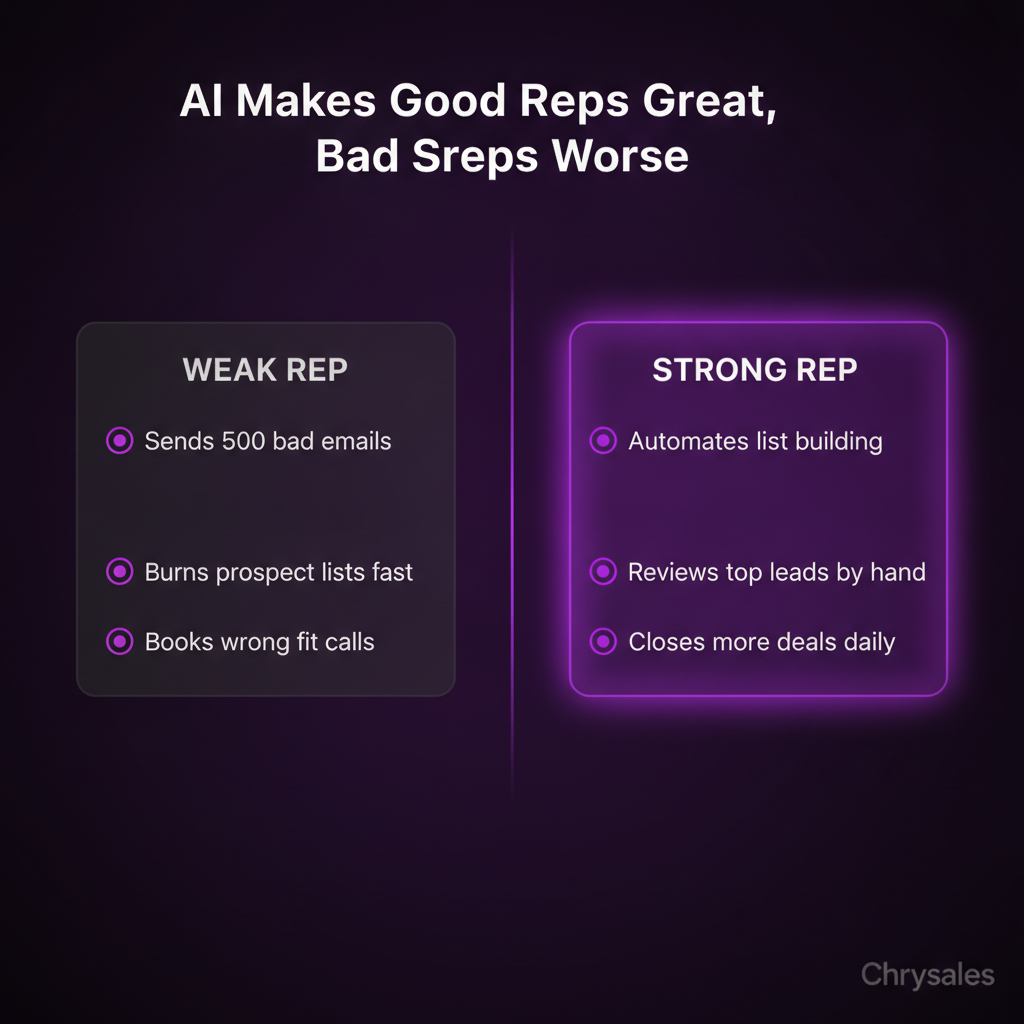
Bad salespeople skip the hard work. They don't research. They don't qualify. They don't listen. AI gives them the ability to skip even more. They can now send 500 emails a day instead of 50. They can book calls with people who were never a fit. They can automate follow-ups that sound robotic because they never learned how to write good ones manually.
The result? Lower reply rates. More unsubscribes. Angry prospects. Burned lists. A 30-person consulting firm we worked with tried this exact approach last year. They used an AI tool to send 10,000 cold emails in two weeks. Reply rate: 0.3%. Meetings booked: four. Three of those four were tire kickers who ghosted after the first call.
Why Great Salespeople Become Unstoppable
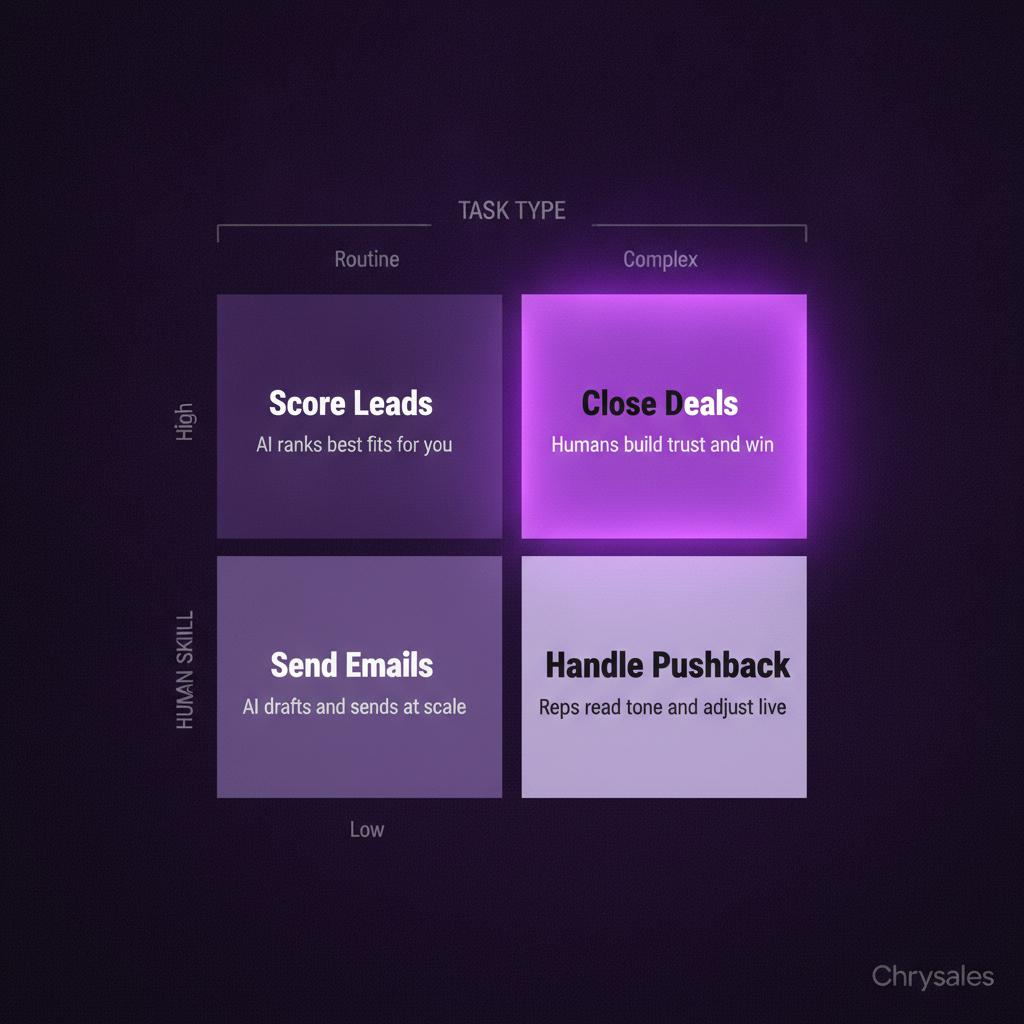
Great salespeople do the opposite. They use AI to remove the repetitive boring stuff so they can focus on the high-value work that actually closes deals. They automate research, lead scoring, CRM updates, and follow-up sequences. Then they spend their time on discovery calls, handling objections, and building relationships.
Picture this: a great closer used to spend two hours a day updating the CRM, writing follow-up emails, and sorting through leads. Now AI does that in 10 minutes. Those two hours? They're now spent on three extra calls. More calls with good-fit prospects equals more closed deals. Simple math.
Pro Tip: The best sales reps we've trained use AI for speed, not replacement. They automate list building and lead enrichment, then personally review the top 20% before outreach. That's the combo that works. You can watch how to survive in the AI era that kills most businesses for more on this approach.
The Three Places AI Actually Moves the Needle in B2B Sales
Not all AI sales tools are created equal. Some are gimmicks. Some are game changers. After working with 500+ sales teams and helping generate over €10M in client revenue, we've seen what works. Here are the three areas where AI actually delivers results.
Lead Scoring and Prioritization
Most sales teams treat every lead the same. AI fixes that. You can score leads based on company size, tech stack, recent funding, job changes, website visits, email opens, and dozens of other signals. Then you focus your energy on the leads that actually matter, a strategy backed by research on how AI-driven lead scoring improves conversion rates.
Think of your sales pipeline like a phone contact list. If half the numbers don't work, no message gets through. AI helps you find the working numbers first.
A marketing agency we worked with was calling 100 leads a week with a 2% conversion rate. After adding AI lead scoring, they called 40 leads a week (the top-scored ones) and conversion jumped to 8%. Less work. Better results.
Set a simple rule: anything scoring above 70 goes to the top of your call list. Anything below 40 gets a low-touch email sequence. This alone will change your close rate.
Outbound Personalization at Scale
Writing personalized cold emails to 200 people takes forever. AI can research each prospect, pull relevant info (recent LinkedIn post, company news, job change), and draft a custom first line in seconds. You review it, tweak it if needed, and send.
Here's the thing: AI-generated personalization is not the same as real personalization. Real personalization means you actually understand the prospect's problem and speak to it. AI can help you get 80% there by doing the research and drafting. You add the final 20% by making it sound human and tying it to your offer, as detailed in best practices for cold email personalization at scale.
Common mistake: Letting AI write the whole email from scratch with no human review. Prospects can tell. It sounds like a template pretending to be personal. Always add your voice.
Automated Follow-Up Sequences
Most deals don't close on the first call. They close on the fourth or fifth touch. The problem? Most salespeople forget to follow up, or they do it inconsistently.
AI-powered sales automation for consultants fixes this by running the follow-up sequence for you. You set up the sequence once. If a prospect opens your email but doesn't reply, AI waits two days and sends follow-up #1. If they still don't reply, it waits three more days and sends follow-up #2. If they click a link, it notifies you so you can jump in personally. The system runs 24/7 without you thinking about it.
One tech company we worked with had a 12% reply rate on first emails. After adding a five-email automated sequence (with AI tracking engagement), their total reply rate across the sequence hit 31%. Same list. Same offer. Better follow-up. For templates that work, check out these proven cold email follow-up templates.
Where AI Falls Flat (and Always Will)
AI is not magic. There are huge parts of B2B sales where it adds zero value, or worse, makes things awkward. If you try to automate these, you'll lose deals.
Discovery Calls and Objection Handling
You can't automate listening. A good discovery call is about reading tone, asking follow-up questions based on what the prospect just said, and adjusting your pitch in real time. AI can give you a script. It can't read the room.
Objection handling is the same. When a prospect says "your price is too high," the real objection might be "I don't see the value yet" or "I need to convince my boss" or "I'm comparing you to a cheaper option." A good salesperson digs deeper. An AI tool just spits out a canned response.
Watch out: Some AI tools claim they can "handle objections for you" via chatbot. Do not use these for high-ticket B2B sales. They kill trust faster than anything.
Building Trust and Closing Complex Deals
Trust is built through consistency, honesty, and proving you understand the prospect's world. That takes time and human interaction, as highlighted in analysis of why AI can scale sales but cannot build trust.
If you're selling a $50K consulting engagement or a six-figure software deal, the prospect wants to talk to a real person who gets their pain and can deliver a solution. AI can book the meeting. It can send the proposal. It can remind the prospect to sign. But it can't build the relationship that makes them choose you over three other options.
Hiring and Training Sales Teams
Hiring salespeople is still a human game. You need to assess personality, resilience, coachability, and culture fit. AI can screen resumes and schedule interviews, but it can't tell you if someone will thrive in your environment.
Same with training. You can use AI to deliver onboarding content or quiz new hires on product knowledge. But teaching someone how to run a discovery call, handle a tough objection, or close under pressure? That requires live coaching, role-play, and feedback from someone who's been there.
We've trained over 1,000 business owners and 500+ sales teams. The ones who succeed get hands-on coaching, not a course or a bot.
How to Build an AI-Powered Sales System That Actually Works
Most teams either ignore AI completely or go all-in without a plan. Both approaches fail. Here's the right way to think about sales automation for consultants, agencies, and B2B companies.
Start with the System, Then Add AI
Your sales system is the foundation. That means a clear process for how leads enter your pipeline, how they get qualified, what happens on discovery calls, how proposals get sent, and how deals get closed. If that process is a mess, AI won't fix it.
Here's what we see all the time with new clients: they have five different tools, no documented process, and every salesperson doing their own thing. Adding AI to that setup just creates faster chaos.
Fix the system first. Document your process. Build your offer. Train your team on the same call structure and pitch. Then look at where AI can remove manual work. To see a complete framework, explore the only AI sales system you need in 2026.
Pick AI Tools Based on Gaps, Not Hype
Don't buy an AI tool because it's trending on LinkedIn. Buy it because it solves a specific problem you have right now.
If your biggest bottleneck is list building, get an AI tool for lead generation and lead enrichment. If it's follow-up, get an email automation platform with AI sequencing. If it's CRM admin work, get an AI assistant that logs calls and updates deal stages.
A 15-person consulting firm doesn't need the same AI stack as a 200-person agency. Start small. Add one tool. Make sure it works. Then add the next.
Pro Tip: Most sales teams only need three core AI tools: one for lead data and scoring, one for email automation, and one for CRM integration. Anything beyond that is usually overkill.
Use AI for Speed, Humans for Strategy
This is the golden rule. AI handles repetitive tasks. Humans handle decisions, as outlined in our comprehensive AI sales enablement guide.
AI can pull a list of 500 companies that match your ICP. A human decides which 50 to prioritize this week. AI can draft an outreach email. A human reviews it and adds the hook that makes it convert.
The companies that win with AI in B2B sales are the ones that treat it like a smart assistant, not a replacement. Your sales team should be spending more time talking to prospects and less time doing admin work. That's the whole point.
Real Examples: What This Looks Like in Practice
Here's how AI is making great salespeople unstoppable right now, pulled from real clients and case studies.
Example 1: Automated Lead Scoring for a SaaS Consultancy
A 20-person SaaS consulting firm was manually reviewing 300 inbound leads a month. Half were bad fits (wrong company size, wrong industry, wrong budget). Their sales team wasted hours on discovery calls that went nowhere.
We built them an AI lead scoring system using their CRM data and a tool that enriches company info automatically. Every new lead gets scored based on employee count, tech stack, funding stage, and website activity. Leads scoring 80+ get a same-day call. Leads scoring 50 to 79 get a personalized email sequence. Leads below 50 get a monthly newsletter.
Result: sales team now focuses on 80 high-quality leads a month instead of 300 random ones. Close rate went from 4% to 11% in one quarter.
Example 2: Personalized Outbound at Scale for an IT Agency
A managed IT services agency wanted to do cold outbound but didn't have time to research and personalize emails for 500 companies. They tried a generic spray-and-pray campaign. Reply rate: 0.8%.
We set them up with an AI tool that pulls recent news, LinkedIn activity, and tech stack data for each prospect. The AI drafts a custom first line. Their BDR reviews and tweaks each batch (takes 15 minutes for 50 emails). The rest of the email is a tested template.
New reply rate: 6.2%. Meetings booked jumped from two a month to 14 a month. Same offer. Same target market. Better personalization. To implement this approach step by step, follow our AI outbound automation system guide.
Example 3: Follow-Up Automation for a Marketing Agency
A marketing agency had a great first-touch email but terrible follow-up discipline. Deals were getting lost because reps forgot to follow up, or followed up too late.
We built a five-email automated sequence triggered by engagement signals (opens, clicks, no reply). AI handles the sends and tracks behavior. If a prospect clicks the calendar link but doesn't book, the system flags the rep to call them directly.
Before automation: 18% of cold leads eventually replied. After: 34% replied somewhere in the sequence. The agency went from booking 6 new discovery calls a month to 19. You can watch how an AI sales system delivers record revenue with unlimited demand to see the full workflow in action.
Frequently Asked Questions
Q: Can AI actually write good cold emails, or do I still need a human?
AI can write decent first drafts, especially if you feed it examples of emails that worked for you in the past. But it still needs a human to review and tweak. The best approach is to let AI handle research and draft the personalized first line, then you add the hook and call to action. If you send 100% AI-written emails with no review, prospects will smell it. The tone feels off. Always add your voice.
Q: What's the biggest mistake teams make when adding AI to their sales process?
Skipping the foundations. They try to automate a broken process and wonder why results get worse, not better. If your offer is weak, your list is bad, or your sales team doesn't know how to close, AI will just scale the problem. Fix your sales system first. Then add AI to remove repetitive work. That order matters.
Q: How do I know which AI tools are actually worth paying for?
Start by identifying your biggest time-suck or bottleneck. Is it building lists? Scoring leads? Writing follow-ups? Updating the CRM? Pick one problem and find a tool that solves it. Test it for 30 days. If it saves your team five hours a week, it's worth it. If it doesn't, cut it and try something else. Don't buy a tool just because everyone's talking about it.
Q: Will AI replace salespeople completely in the next few years?
No. AI will replace bad salespeople who just send templated emails and read scripts. It won't replace great salespeople who listen, build trust, handle complex objections, and close deals through relationships. B2B sales, especially high-ticket sales, is still a human game. AI makes the good ones faster and better. It exposes the weak ones and pushes them out.
Q: Can small sales teams compete with big teams now that AI levels the playing field?
Absolutely. A three-person sales team with a smart AI-powered sales system can outperform a 20-person team running on hustle and chaos. AI removes the advantage of having more bodies. What matters now is having a clear process, a strong offer, and the discipline to use AI for the right tasks. Small teams that get this right are booking more meetings and closing more deals than bloated teams stuck in old-school tactics.
Sales automation for consultants is the use of AI and software to handle repetitive sales tasks, so teams can focus on judgment, outreach, and closing deals. Here's something most people miss: AI doesn't make bad sales reps good. It makes them fail faster and louder. At the same time, it turns already solid salespeople into absolute machines. The gap between the two is getting wider every month, and if you're building a B2B sales system right now, you need to understand why this is happening.
The AI Sales Paradox Nobody Talks About
Most teams think AI sales tools are a magic fix. You plug in some software, automate your outreach, and suddenly your pipeline fills up. That's not how it works. AI doesn't replace judgment. It amplifies whatever approach you already have. If your sales process is broken, AI will scale that broken process to 10x the volume, a problem explored in depth by experts who warn against adding AI to broken sales processes. If your list is garbage, AI will contact garbage leads faster. If your messaging is weak, AI will blast weak messaging to thousands of people before you realize the mistake.
Watch out: Teams that jump straight to AI without fixing their foundational sales system end up burning through prospect lists in weeks, not months. Once your domain reputation tanks from mass low-quality outreach, it's hard to recover.
Why Bad Salespeople Get Worse with AI
Bad salespeople skip the hard work. They don't research. They don't qualify. They don't listen. AI gives them the ability to skip even more. They can now send 500 emails a day instead of 50. They can book calls with people who were never a fit. They can automate follow-ups that sound robotic because they never learned how to write good ones manually.
The result? Lower reply rates. More unsubscribes. Angry prospects. Burned lists. A 30-person consulting firm we worked with tried this exact approach last year. They used an AI tool to send 10,000 cold emails in two weeks. Reply rate: 0.3%. Meetings booked: four. Three of those four were tire kickers who ghosted after the first call.
Why Great Salespeople Become Unstoppable
Great salespeople do the opposite. They use AI to remove the repetitive boring stuff so they can focus on the high-value work that actually closes deals. They automate research, lead scoring, CRM updates, and follow-up sequences. Then they spend their time on discovery calls, handling objections, and building relationships.
Picture this: a great closer used to spend two hours a day updating the CRM, writing follow-up emails, and sorting through leads. Now AI does that in 10 minutes. Those two hours? They're now spent on three extra calls. More calls with good-fit prospects equals more closed deals. Simple math.
Pro Tip: The best sales reps we've trained use AI for speed, not replacement. They automate list building and lead enrichment, then personally review the top 20% before outreach. That's the combo that works. You can watch how to survive in the AI era that kills most businesses for more on this approach.
The Three Places AI Actually Moves the Needle in B2B Sales
Not all AI sales tools are created equal. Some are gimmicks. Some are game changers. After working with 500+ sales teams and helping generate over €10M in client revenue, we've seen what works. Here are the three areas where AI actually delivers results.
Lead Scoring and Prioritization
Most sales teams treat every lead the same. AI fixes that. You can score leads based on company size, tech stack, recent funding, job changes, website visits, email opens, and dozens of other signals. Then you focus your energy on the leads that actually matter, a strategy backed by research on how AI-driven lead scoring improves conversion rates.
Think of your sales pipeline like a phone contact list. If half the numbers don't work, no message gets through. AI helps you find the working numbers first.
A marketing agency we worked with was calling 100 leads a week with a 2% conversion rate. After adding AI lead scoring, they called 40 leads a week (the top-scored ones) and conversion jumped to 8%. Less work. Better results.
Set a simple rule: anything scoring above 70 goes to the top of your call list. Anything below 40 gets a low-touch email sequence. This alone will change your close rate.
Outbound Personalization at Scale
Writing personalized cold emails to 200 people takes forever. AI can research each prospect, pull relevant info (recent LinkedIn post, company news, job change), and draft a custom first line in seconds. You review it, tweak it if needed, and send.
Here's the thing: AI-generated personalization is not the same as real personalization. Real personalization means you actually understand the prospect's problem and speak to it. AI can help you get 80% there by doing the research and drafting. You add the final 20% by making it sound human and tying it to your offer, as detailed in best practices for cold email personalization at scale.
Common mistake: Letting AI write the whole email from scratch with no human review. Prospects can tell. It sounds like a template pretending to be personal. Always add your voice.
Automated Follow-Up Sequences
Most deals don't close on the first call. They close on the fourth or fifth touch. The problem? Most salespeople forget to follow up, or they do it inconsistently.
AI-powered sales automation for consultants fixes this by running the follow-up sequence for you. You set up the sequence once. If a prospect opens your email but doesn't reply, AI waits two days and sends follow-up #1. If they still don't reply, it waits three more days and sends follow-up #2. If they click a link, it notifies you so you can jump in personally. The system runs 24/7 without you thinking about it.
One tech company we worked with had a 12% reply rate on first emails. After adding a five-email automated sequence (with AI tracking engagement), their total reply rate across the sequence hit 31%. Same list. Same offer. Better follow-up. For templates that work, check out these proven cold email follow-up templates.
Where AI Falls Flat (and Always Will)
AI is not magic. There are huge parts of B2B sales where it adds zero value, or worse, makes things awkward. If you try to automate these, you'll lose deals.
Discovery Calls and Objection Handling
You can't automate listening. A good discovery call is about reading tone, asking follow-up questions based on what the prospect just said, and adjusting your pitch in real time. AI can give you a script. It can't read the room.
Objection handling is the same. When a prospect says "your price is too high," the real objection might be "I don't see the value yet" or "I need to convince my boss" or "I'm comparing you to a cheaper option." A good salesperson digs deeper. An AI tool just spits out a canned response.
Watch out: Some AI tools claim they can "handle objections for you" via chatbot. Do not use these for high-ticket B2B sales. They kill trust faster than anything.
Building Trust and Closing Complex Deals
Trust is built through consistency, honesty, and proving you understand the prospect's world. That takes time and human interaction, as highlighted in analysis of why AI can scale sales but cannot build trust.
If you're selling a $50K consulting engagement or a six-figure software deal, the prospect wants to talk to a real person who gets their pain and can deliver a solution. AI can book the meeting. It can send the proposal. It can remind the prospect to sign. But it can't build the relationship that makes them choose you over three other options.
Hiring and Training Sales Teams
Hiring salespeople is still a human game. You need to assess personality, resilience, coachability, and culture fit. AI can screen resumes and schedule interviews, but it can't tell you if someone will thrive in your environment.
Same with training. You can use AI to deliver onboarding content or quiz new hires on product knowledge. But teaching someone how to run a discovery call, handle a tough objection, or close under pressure? That requires live coaching, role-play, and feedback from someone who's been there.
We've trained over 1,000 business owners and 500+ sales teams. The ones who succeed get hands-on coaching, not a course or a bot.
How to Build an AI-Powered Sales System That Actually Works
Most teams either ignore AI completely or go all-in without a plan. Both approaches fail. Here's the right way to think about sales automation for consultants, agencies, and B2B companies.
Start with the System, Then Add AI
Your sales system is the foundation. That means a clear process for how leads enter your pipeline, how they get qualified, what happens on discovery calls, how proposals get sent, and how deals get closed. If that process is a mess, AI won't fix it.
Here's what we see all the time with new clients: they have five different tools, no documented process, and every salesperson doing their own thing. Adding AI to that setup just creates faster chaos.
Fix the system first. Document your process. Build your offer. Train your team on the same call structure and pitch. Then look at where AI can remove manual work. To see a complete framework, explore the only AI sales system you need in 2026.
Pick AI Tools Based on Gaps, Not Hype
Don't buy an AI tool because it's trending on LinkedIn. Buy it because it solves a specific problem you have right now.
If your biggest bottleneck is list building, get an AI tool for lead generation and lead enrichment. If it's follow-up, get an email automation platform with AI sequencing. If it's CRM admin work, get an AI assistant that logs calls and updates deal stages.
A 15-person consulting firm doesn't need the same AI stack as a 200-person agency. Start small. Add one tool. Make sure it works. Then add the next.
Pro Tip: Most sales teams only need three core AI tools: one for lead data and scoring, one for email automation, and one for CRM integration. Anything beyond that is usually overkill.
Use AI for Speed, Humans for Strategy
This is the golden rule. AI handles repetitive tasks. Humans handle decisions, as outlined in our comprehensive AI sales enablement guide.
AI can pull a list of 500 companies that match your ICP. A human decides which 50 to prioritize this week. AI can draft an outreach email. A human reviews it and adds the hook that makes it convert.
The companies that win with AI in B2B sales are the ones that treat it like a smart assistant, not a replacement. Your sales team should be spending more time talking to prospects and less time doing admin work. That's the whole point.
Real Examples: What This Looks Like in Practice
Here's how AI is making great salespeople unstoppable right now, pulled from real clients and case studies.
Example 1: Automated Lead Scoring for a SaaS Consultancy
A 20-person SaaS consulting firm was manually reviewing 300 inbound leads a month. Half were bad fits (wrong company size, wrong industry, wrong budget). Their sales team wasted hours on discovery calls that went nowhere.
We built them an AI lead scoring system using their CRM data and a tool that enriches company info automatically. Every new lead gets scored based on employee count, tech stack, funding stage, and website activity. Leads scoring 80+ get a same-day call. Leads scoring 50 to 79 get a personalized email sequence. Leads below 50 get a monthly newsletter.
Result: sales team now focuses on 80 high-quality leads a month instead of 300 random ones. Close rate went from 4% to 11% in one quarter.
Example 2: Personalized Outbound at Scale for an IT Agency
A managed IT services agency wanted to do cold outbound but didn't have time to research and personalize emails for 500 companies. They tried a generic spray-and-pray campaign. Reply rate: 0.8%.
We set them up with an AI tool that pulls recent news, LinkedIn activity, and tech stack data for each prospect. The AI drafts a custom first line. Their BDR reviews and tweaks each batch (takes 15 minutes for 50 emails). The rest of the email is a tested template.
New reply rate: 6.2%. Meetings booked jumped from two a month to 14 a month. Same offer. Same target market. Better personalization. To implement this approach step by step, follow our AI outbound automation system guide.
Example 3: Follow-Up Automation for a Marketing Agency
A marketing agency had a great first-touch email but terrible follow-up discipline. Deals were getting lost because reps forgot to follow up, or followed up too late.
We built a five-email automated sequence triggered by engagement signals (opens, clicks, no reply). AI handles the sends and tracks behavior. If a prospect clicks the calendar link but doesn't book, the system flags the rep to call them directly.
Before automation: 18% of cold leads eventually replied. After: 34% replied somewhere in the sequence. The agency went from booking 6 new discovery calls a month to 19. You can watch how an AI sales system delivers record revenue with unlimited demand to see the full workflow in action.
Frequently Asked Questions
Q: Can AI actually write good cold emails, or do I still need a human?
AI can write decent first drafts, especially if you feed it examples of emails that worked for you in the past. But it still needs a human to review and tweak. The best approach is to let AI handle research and draft the personalized first line, then you add the hook and call to action. If you send 100% AI-written emails with no review, prospects will smell it. The tone feels off. Always add your voice.
Q: What's the biggest mistake teams make when adding AI to their sales process?
Skipping the foundations. They try to automate a broken process and wonder why results get worse, not better. If your offer is weak, your list is bad, or your sales team doesn't know how to close, AI will just scale the problem. Fix your sales system first. Then add AI to remove repetitive work. That order matters.
Q: How do I know which AI tools are actually worth paying for?
Start by identifying your biggest time-suck or bottleneck. Is it building lists? Scoring leads? Writing follow-ups? Updating the CRM? Pick one problem and find a tool that solves it. Test it for 30 days. If it saves your team five hours a week, it's worth it. If it doesn't, cut it and try something else. Don't buy a tool just because everyone's talking about it.
Q: Will AI replace salespeople completely in the next few years?
No. AI will replace bad salespeople who just send templated emails and read scripts. It won't replace great salespeople who listen, build trust, handle complex objections, and close deals through relationships. B2B sales, especially high-ticket sales, is still a human game. AI makes the good ones faster and better. It exposes the weak ones and pushes them out.
Q: Can small sales teams compete with big teams now that AI levels the playing field?
Absolutely. A three-person sales team with a smart AI-powered sales system can outperform a 20-person team running on hustle and chaos. AI removes the advantage of having more bodies. What matters now is having a clear process, a strong offer, and the discipline to use AI for the right tasks. Small teams that get this right are booking more meetings and closing more deals than bloated teams stuck in old-school tactics.
Scaling Is Not Hard If You Have The Right Systems
If you’re serious about leveling up your scaling game, you need the right system, the right training, and the right team behind you. We're here to give you the exact tools and strategies top entrepreneurs use to dominate.

Discover the latest tips
View All.avif)
Chrysales was formed from the words "chrysalis" the stage where a caterpillar transforms into a butterfly and "sales".
It stands for one thing: sales transformation.Because scaling doesn’t happen by doing more of the same. Scaling only happens when you go through real transformation in your systems, your offer, team and the way you sell.
.avif)


