.avif)
14 Best AI SDR Tools for B2B Sales in 2025
The best ai sdr tools 2025 help sales teams automate prospecting, research, outreach, and follow up for b2b sales and lead generation without doing every step by hand.
Picture this: you spend three weeks perfecting your cold email copy, hit send on 2,000 messages, and get 11 replies. Four are out-of-office autoreplies. Three are unsubscribes. The rest say "not interested." Sound familiar?
The problem usually isn't your message. It's that you're doing the work manually while your competitors are booking 15 meetings a week with the best AI SDR tools handling the heavy lifting.
These tools don't just send emails faster. They research leads, score buyers, personalize at scale, and follow up without you lifting a finger.
But here's the catch: most AI SDR software is overhyped garbage that floods inboxes with spammy outreach and tanks your domain reputation.
We tested the top AI SDR tools in 2025 to find the ones that actually deliver qualified pipeline, not just inbox noise.
What AI SDR Tools Actually Do (And What They Don't)
Let's clear up the confusion first. An AI SDR tool automates the grunt work of B2B lead generation: finding prospects, researching their company, writing personalized messages, sending sequences, booking meetings, and following up.
Think of it as a junior salesperson who never sleeps, never takes lunch, and doesn't need training on your CRM.
Here's what the best AI SDR tools handle well in 2025:
- Lead research at scale: scraping LinkedIn, company websites, and databases to build lists in minutes instead of days
- Personalized outreach: writing custom first lines based on recent funding, job changes, or company news
- Multi-channel sequences: coordinating cold email, LinkedIn messages, and follow-ups across 6-12 touchpoints
- Meeting scheduling: integrating with your calendar and booking calls automatically when a prospect replies
Now, what AI SDR software can't do (no matter what the landing page promises): close deals, handle complex objections, or replace a skilled closer. The best automated sales outreach tools get prospects to say "tell me more." A human still needs to run the actual sales call.
Watch out: Most AI-powered SDR platforms sound amazing in demos but fall apart when you plug in real data. Low reply rates (under 2%) and deliverability issues are the top complaints we hear from teams who tried tools like Artisan or 11x without a solid sales system underneath.
The Shift From Fully Autonomous to Hybrid Models
Early AI SDR tools promised "set it and forget it" automation. Send 10,000 emails, sit back, watch meetings roll in. That didn't happen.
Reply rates tanked, domains got blacklisted, and prospects started ignoring anything that smelled like AI-generated outreach.
The best AI SDR tools in 2025 take a hybrid approach: AI handles research, list building, and first-draft messaging, but humans review sequences, approve personalization, and jump in when a lead warms up.
Think of it like autocorrect on your phone. It speeds you up, but you still write the message.
Common mistake: Turning on an AI SDR tool without reviewing the first 100 messages it sends. We've seen tools reference outdated LinkedIn posts, congratulate someone on a job they left two years ago, and pitch products to people who already use them. Always spot-check the first week.
Top 14 AI SDR Tools: What Makes Them Different
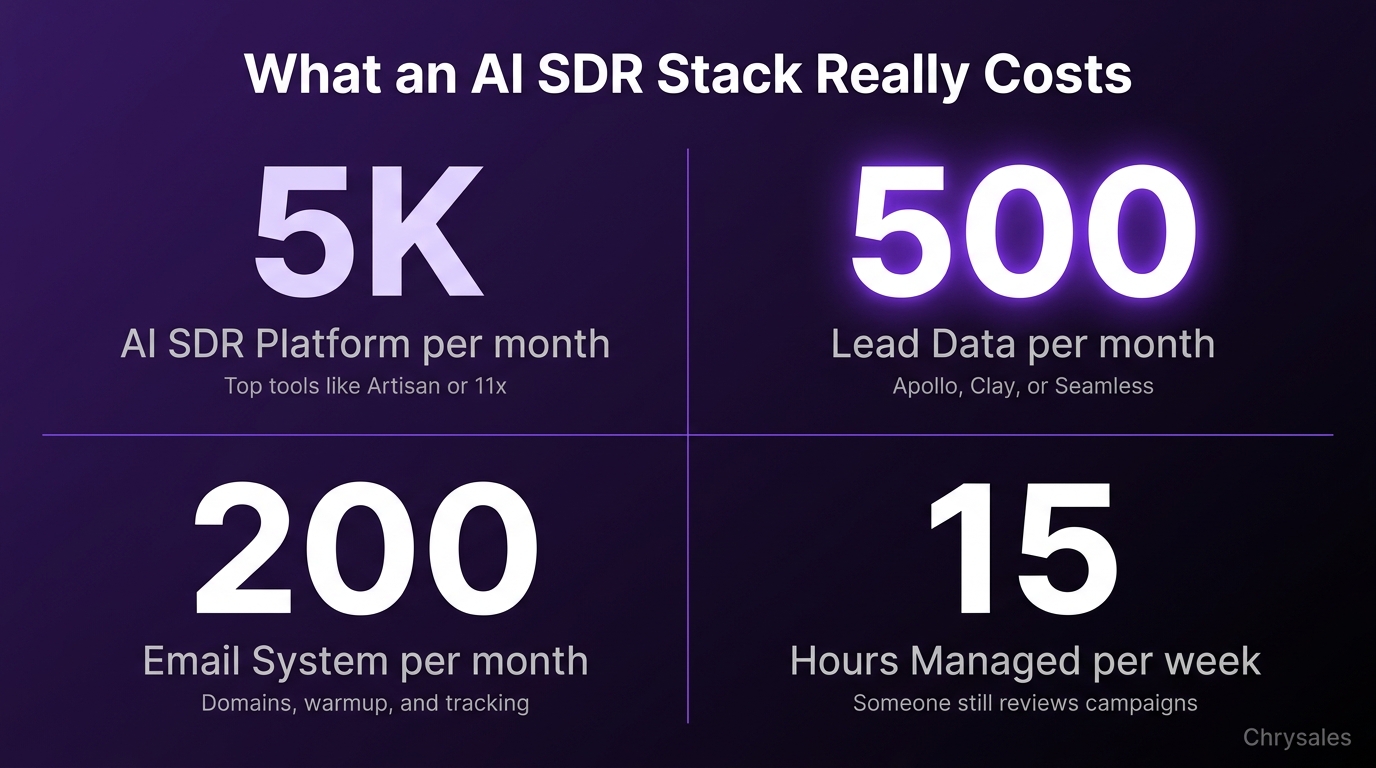
We ranked these tools based on actual pipeline performance, not flashy features. Each one excels at a specific part of the outbound sales automation process. Here's the breakdown.
1. Clay: Best for Data Enrichment and Custom Workflows
Clay isn't technically an AI SDR platform. It's a data enrichment and workflow tool that pulls info from 50+ sources (LinkedIn, Crunchbase, company websites) and lets you build custom lead scoring and personalization logic.
If you want full control over how your AI SDR tool sources and scores leads, Clay is the foundation.
Best for: Teams with in-house sales ops or a technical cofounder who can build workflows. Not plug-and-play, but incredibly powerful once set up.
Pricing: Starts around $149/month for 10,000 enrichment credits.
Pro Tip: Use Clay to build your lead list and scoring model, then export to a tool like Smartlead or Instantly for the actual sending. Clay + a sending tool is a killer combo for B2B sales prospecting.
2. Artisan (Ava): Best for Fully Managed AI Outreach
Artisan's AI agent, Ava, is one of the most polished AI-powered SDR products on the market. It handles research, writing, sending, and follow-ups in a single platform.
The pitch is simple: hire Ava instead of hiring an SDR.
The reality? Ava works well for high-volume top-of-funnel outreach if your ideal customer profile is simple and your offer is clear. But personalization quality drops when targeting niche industries or complex buyer personas.
Best for: Small sales teams that need to scale outbound fast without hiring, especially in broad B2B markets like SaaS or consulting.
Pricing: Around $3,000 to $5,000/month depending on volume.
Watch out: Ava's messaging can sound generic if you don't spend time dialing in your ICP and offer positioning. We've seen reply rates range from 1.5% to 6% depending on how well the account is configured.
3. 11x.ai: Best for Multi-Channel Outbound Sequences
11x positions itself as an AI sales team, not just a tool. Their AI SDR agents handle email, LinkedIn, and even phone outreach in coordinated sequences.
If a lead opens three emails but doesn't reply, the AI shifts to LinkedIn. If they engage on LinkedIn, it books a call. The multi-channel coordination is genuinely impressive, but it comes with a steep learning curve and higher costs than most AI SDR software.
Best for: Mid-sized B2B companies (20 to 100 employees) doing complex outbound campaigns across multiple channels.
Pricing: Custom pricing, typically $5,000 to $10,000+/month.
Common mistake: Trying to run 11x without a clear sales system first. If your offer, positioning, and ICP are fuzzy, the AI will just send more bad messages faster.
4. Instantly.ai: Best Budget Option for Cold Email at Scale
Instantly is the go-to AI SDR tool for teams that want simple, effective cold email automation without the AI hype. It's not a fully autonomous SDR. It's a sending platform with built-in AI features like email warmup, deliverability monitoring, and basic personalization.
You still write the sequences, but Instantly handles sending, domain rotation, and inbox placement so your emails actually land.
Best for: Anyone doing high-volume cold email on a budget. Instantly works for solo consultants, small agencies, and lean sales teams.
Pricing: Starts at $37/month for 1,000 contacts, scales up based on volume.
Pro Tip: Pair Instantly with Clay or Apollo for lead enrichment. Instantly is the sender, not the researcher. This combo is how a lot of smart sales teams run automated sales outreach without spending $5K/month on a fancy AI SDR platform.
5. Smartlead: Best for Deliverability and Inbox Management
Smartlead is similar to Instantly but with better deliverability tools. It rotates sending across multiple domains, warms up inboxes automatically, and monitors spam scores in real time.
If you've ever had a domain blacklisted or watched your reply rates drop to 0.3% overnight, Smartlead solves that.
The AI features are lighter than tools like 11x or Artisan, but the core cold email infrastructure is rock solid.
Best for: Teams sending 10,000+ cold emails per month who need bulletproof deliverability.
Pricing: Starts around $39/month, scales based on volume.
6. Apollo.io: Best All-in-One B2B Lead Generation Platform
Apollo is a CRM, lead database, and outbound automation tool rolled into one. It's not pure AI SDR software, but it has built-in AI features for email writing, lead scoring, and sequence optimization.
The real value is the database: 270+ million contacts with verified emails and intent signals. If you want one tool that handles prospecting, outreach, and pipeline tracking, Apollo is hard to beat.
Best for: B2B sales teams that want an all-in-one platform and don't want to stitch together Clay + Instantly + HubSpot.
Pricing: Free plan available, paid plans start at $49/user/month.
Watch out: Apollo's AI writing features are decent but not amazing. You'll still need to customize templates heavily for best results.
7. Lemlist: Best for Creative Personalization Features
Lemlist stands out with creative personalization options: AI-generated images, custom landing pages for each prospect, video thumbnails in emails. It's less about volume and more about making each message feel handcrafted.
The AI SDR features are newer (added in 2024) and include smart scheduling, auto-follow-ups, and basic lead scoring.
Best for: Agencies and consultants targeting high-value accounts where creative outreach makes a difference.
Pricing: Starts around $59/month.
8. Reply.io: Best for Hybrid Human + AI Teams
Reply.io positions itself as a platform where AI SDR agents work alongside human reps. The AI handles research and first outreach, then hands off warm leads to human closers.
This hybrid model is what most B2B sales teams actually need in 2025. Reply also includes built-in email verification, LinkedIn automation, and a solid CRM integration layer.
Best for: Teams scaling from 1 to 2 salespeople to 5 to 10, where you need automation but still want humans driving closing conversations.
Pricing: Starts at $60/user/month.
9. Outreach: Best for Enterprise Sales Teams
Outreach is one of the OG sales engagement platforms, now with AI features layered in. It's overkill for most small teams, but if you're running a 20+ person sales org with complex deal cycles, Outreach gives you enterprise-grade analytics, compliance tools, and AI-powered deal insights.
Best for: Companies with $10M+ in revenue and dedicated sales ops teams.
Pricing: Custom enterprise pricing, typically $100+/user/month.
10. Salesoft (Drift's AI SDR): Best for Inbound + Outbound Combo
Salesloft is similar to Outreach but with stronger AI SDR features for combining inbound and outbound. If you're running ads, content marketing, and cold outreach at the same time, Salesloft's AI helps prioritize which leads to hit with outbound sequences based on intent signals.
Best for: Marketing agencies and SaaS companies doing full-funnel B2B lead generation.
Pricing: Custom pricing, similar range to Outreach.
11. Jason AI (from Reply.io): Best Conversational AI SDR
Jason AI is Reply.io's standalone conversational AI agent. It chats with leads via email like a human rep, answers common questions, handles objections, and books meetings.
It's closer to a chatbot than a traditional AI SDR tool, but it works surprisingly well for simple qualifying conversations.
Best for: High-volume lead gen where you need to qualify and book meetings fast without human touch.
Pricing: Bundled with Reply.io plans or available standalone starting around $80/month.
12. Seamless.ai: Best for Real-Time Contact Data
Seamless isn't a full AI SDR platform, but it's one of the best tools for finding verified contact info in real time. The Chrome extension pulls emails and phone numbers while you browse LinkedIn or company sites.
Pair it with any sending tool and you've got a solid outbound stack.
Best for: Sales reps who prospect manually and need fast, accurate contact data.
Pricing: Starts around $147/month for individuals.
Pro Tip: Use Seamless for lead research, export to Clay for enrichment, and send through Instantly or Smartlead. That's a sub-$300/month stack that rivals $5K AI SDR platforms.
13. Woodpecker: Best for Simple, No-Frills Cold Email
Woodpecker is the anti-hype AI SDR tool. No flashy landing page, no "AI agent will replace your team" promises. Just clean, effective cold email automation with solid deliverability and simple A/B testing.
If you want to send personalized cold emails at scale without learning a complex platform, Woodpecker is the easiest tool on this list.
Best for: Solo consultants, fractional execs, and small B2B service providers.
Pricing: Starts at $54/month.
14. AiSDR: Best for LinkedIn-First Outreach
AiSDR focuses specifically on LinkedIn automation. It researches profiles, sends connection requests, writes personalized intro messages, and follows up in a sequence.
If your ideal buyers are active on LinkedIn and ignore cold emails, AiSDR is worth testing, and you can explore LinkedIn automation tools for B2B outreach to see how this platform fits into a broader strategy.
Best for: B2B service providers, recruiters, and consultants where LinkedIn is the primary channel.
Pricing: Around $99 to $199/month depending on features.
Common mistake: Running LinkedIn outreach without warming up your account first. LinkedIn's spam filters are aggressive. Start slow (10 to 15 connections per day) and gradually ramp up.
How to Choose the Right AI SDR Tool for Your Team
Most teams pick an AI SDR tool based on features or hype. That's backwards. Start with your sales system, then pick the tool that fits.
Step 1: Define Your ICP and Offer First
A 30-person consulting firm we worked with tried Artisan, burned $12,000 over three months, and booked two meetings. The tool wasn't the problem. They didn't know who their ideal buyer was or what their no-brainer offer looked like. The AI just sent better-formatted bad outreach.
Before you pick any AI SDR software, get crystal clear on:
- Who you're selling to (title, company size, industry, pain point)
- What you're offering (not features, the outcome they care about)
- Why they should take a call (the hook that makes them say "tell me more")
If those three things are fuzzy, no AI SDR tool will save you.
Step 2: Match the Tool to Your Channel
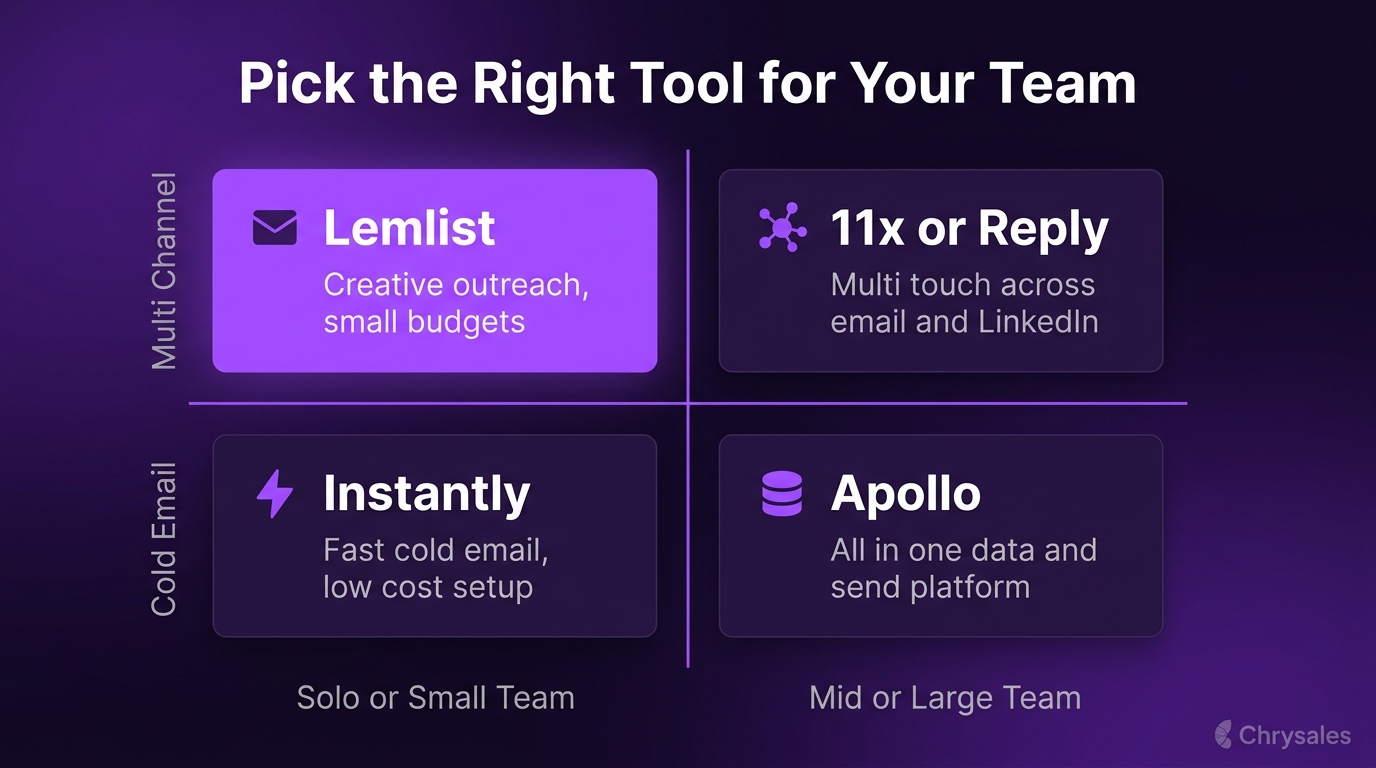
Different AI SDR tools excel on different channels. If your buyers ignore email but respond on LinkedIn, don't buy an email-first platform. If you need multi-touch sequences across email, LinkedIn, and phone, pick a tool like 11x or Reply.io that coordinates channels.
If you're considering tools like 11x or Reply.io for multi-channel SDR automation, you can watch why coordinated multichannel outreach beats spray-and-pray email to see how coordinated touchpoints can 10x your results.
Quick channel guide:
- Cold email only: Instantly, Smartlead, Woodpecker
- LinkedIn only: AiSDR, Expandi
- Multi-channel: 11x, Reply.io, Salesloft
- All-in-one (prospecting + sending): Apollo, Outreach
Step 3: Start Cheap, Prove It Works, Then Scale
Don't sign a $5,000/month contract with Artisan or 11x on day one. Start with a $50 to $150/month tool like Instantly or Lemlist. Run 500 cold emails. Measure your reply rate.
If you hit 3%+ replies and 10%+ of those turn into meetings, you've proven the system works. Now you can scale to a more advanced AI SDR platform.
Pro Tip: Most sales teams waste money on expensive AI SDR tools before proving their messaging works. Test your ICP, offer, and sequences with a cheap tool first. Once you're booking consistent meetings, upgrade to automation that scales.
The Real Cost of AI SDR Tools (Beyond the Monthly Fee)
Here's what nobody tells you: the tool cost is the smallest part of running automated sales outreach.
A typical AI SDR stack costs $2,000 to $6,000 per month when you add everything up:
- AI SDR platform: $500 to $5,000/month depending on volume
- Lead data and enrichment: $150 to $500/month (Apollo, Clay, Seamless)
- Email infrastructure: $50 to $300/month (domains, warmup, SMTP)
- CRM and tracking: $50 to $200/month (HubSpot, Pipedrive)
- Time to manage it all: 5 to 15 hours per week (someone needs to review campaigns, tweak messaging, handle replies)
If you're a solo founder or small team, that time cost is huge. One marketing agency owner told us he spent 12 hours a week managing his AI SDR tool before realizing he could hire a part-time VA to handle replies and book meetings for less than the tool cost.
The best AI SDR tools in 2025 aren't always the fanciest. They're the ones that fit your budget, your ICP, and your actual capacity to manage the system.
Common Mistakes Teams Make With AI SDR Software
We've trained 500+ sales teams and seen these mistakes kill outbound campaigns over and over. Here's what to avoid.
Mistake 1: Buying a Tool Before Building a System
Your AI SDR tool is the last piece, not the first. Most teams buy Artisan or 11x, turn it on, and wonder why results suck. The tool is only as good as the sales system behind it.
Build this first:
- Clear ICP (who you're targeting)
- Validated offer (what you're pitching)
- Proven messaging (cold email or LinkedIn scripts that get replies)
- Lead scoring rules (how you prioritize who to contact)
- Follow-up process (what happens when someone says "interested")
Once those pieces work manually, AI SDR software scales it. If those pieces are broken, automation just breaks them faster.
Watch out: If you can't book 3 to 5 meetings per month doing manual outreach, don't automate yet. Fix the system first.
Mistake 2: Sending High Volume Without Deliverability Setup
A tech company we worked with sent 5,000 cold emails in week one using a new AI SDR tool. By week two, their domain was blacklisted and 90% of emails landed in spam. They had to buy three new domains and start over.
Here's what you need before sending at scale:
- Dedicated sending domains (not your main company domain)
- Email warmup (send 20 to 50 emails per day for 2 to 3 weeks before launching campaigns)
- SPF, DKIM, and DMARC records configured
- Reply monitoring (if your reply rate drops under 1%, stop and fix your list or messaging)
Most AI SDR platforms handle some of this, but not all. Tools like Instantly and Smartlead have built-in warmup and deliverability monitoring. Artisan and 11x assume you handle it yourself.
Mistake 3: Trusting AI Personalization Without Reviewing It
AI-powered SDR tools generate personalized first lines by scraping LinkedIn, company news, and funding announcements. Sounds great. In practice, the AI gets it wrong 20 to 30% of the time.
We've seen AI personalization reference:
- LinkedIn posts from three years ago
- Funding rounds that never happened (hallucinations)
- Job titles the person doesn't have anymore
- Competitors the prospect already hates
Always spot-check the first 50 to 100 messages any AI SDR tool sends. If the personalization is off, tighten your prompts or turn it off and write templates manually.
Common mistake: Assuming the AI knows your industry. It doesn't. The best AI SDR tools let you feed them custom instructions, competitor names, and industry context so the personalization actually makes sense.
How AI SDR Tools Fit Into a Real Sales System
Here's the truth: AI SDR software is just one piece of a repeatable, predictable sales system.
At Chrysales, we've worked with 500+ sales teams and generated €10M+ in client revenue by building systems that start with strategy, not tools.
The four-step method we use with every client:
- Learn: We map your ICP, offer, positioning, and sales process to understand what actually converts.
- Build Systems: We create custom appointment-booking systems, discovery scripts, objection-handling frameworks, and sales call structures that work for your business.
- Automate: Once the system is proven, we layer in AI SDR tools, lead scoring, and outreach automation to scale without adding headcount.
- Hire Chief of Staff: We help you hire and train elite setters and closers who can run the system long-term.
Most teams skip straight to step 3, buy an AI SDR tool, and wonder why it doesn't work. The tool is only useful once steps 1 and 2 are locked in, and you can learn how to build a sales system that actually scales before investing in expensive automation.
Pro Tip: If you're considering hiring a full-time SDR vs. using an AI SDR platform, here's the math: a junior SDR costs $50K to $70K per year plus training time. A good AI SDR tool costs $3K to $6K per month ($36K to $72K per year) and needs zero training. But the AI can't handle complex objections or close deals. Use AI for top-of-funnel prospecting and lead qualification, then hand warm leads to a human closer. That's the model that works best in 2025.
What Reply Rates and Meeting Bookings to Expect
Let's set realistic benchmarks. If someone promises you 15% reply rates and 50 booked meetings per month from cold outreach, they're lying.
Here's what good looks like with the best AI SDR tools in 2025:
- Reply rate: 2 to 6% for cold email, 8 to 15% for LinkedIn
- Positive reply rate: 30 to 50% of replies (the rest are unsubscribes or "not interested")
- Meeting booking rate: 1 to 3 meetings per 100 cold emails sent
- Show rate: 50 to 70% of booked meetings actually happen (no-shows are normal, build buffer into your calendar)
If you send 1,000 cold emails per month with a solid AI SDR tool and good messaging, expect 20 to 60 replies and 10 to 30 booked calls. Half will show. That's 5 to 15 real sales conversations per month.
Not amazing, but enough to build pipeline. Scale to 5,000 emails per month and you're looking at 50 to 150 calls. That's when outbound starts driving real revenue, based on marketing and sales performance benchmarks tracked across thousands of B2B companies.
Watch out: If your reply rate is under 1%, something is broken. Usually the list (targeting the wrong people), the offer (no clear reason to respond), or deliverability (emails landing in spam). Don't scale volume until you fix whichever one is the problem.
Frequently Asked Questions
Q: What is an AI SDR tool and how is it different from a regular email tool?
An AI SDR tool automates research, personalization, and multi-step follow-ups, not just sending. Regular email tools like Mailchimp or Gmail just send messages you write. AI SDR software researches your prospects, writes custom first lines, handles objections in replies, and books meetings automatically. Think junior salesperson vs. email sender.
Q: Can AI SDR tools actually replace a human salesperson?
Not fully, at least not in 2025. The best AI SDR tools handle top-of-funnel prospecting, research, and lead qualification better and faster than humans. But they can't handle complex objections, build deep relationships, or close high-ticket deals. Use AI for prospecting and lead nurturing, humans for discovery calls and closing.
Q: How much do AI SDR tools cost per month?
Depends on the tool and volume. Budget options like Instantly or Woodpecker start around $40 to $60/month. Mid-tier platforms like Lemlist, Reply.io, and Apollo run $100 to $300/month. Enterprise AI SDR software like Artisan, 11x, or Outreach costs $3,000 to $10,000+/month. Most small B2B teams should start under $200/month and scale once they prove the system works.
Q: What reply rate should I expect from AI-powered outreach?
Good cold email gets 2 to 6% reply rates. LinkedIn outreach gets 8 to 15%. If you're under 1%, your list is bad, your offer is unclear, or your emails are landing in spam. Don't blame the AI SDR tool until you've tested your messaging with 500+ sends and reviewed deliverability. Most reply rate problems are list quality or offer issues, not the tool, and learning to write cold emails that get replies manually first will help you understand what works before scaling with AI.
Q: Do I need technical skills to use AI SDR software?
Most tools like Instantly, Lemlist, and Apollo are plug-and-play. You can set up campaigns in an hour with no coding. More advanced platforms like Clay or 11x require some technical setup and understanding of APIs and workflows. If you're not technical, start with a simple tool or hire a sales ops person to manage the stack.
Q: What's the difference between AI SDR tools and lead generation agencies?
AI SDR tools give you the software to run outbound yourself. You build the lists, write the messaging, and manage campaigns. Lead gen agencies do it for you but charge $3,000 to $10,000+ per month plus setup fees. Tools are cheaper but require your time. Agencies are hands-off but expensive. Chrysales is different: we build custom sales systems and train your team to run them, so you're not stuck paying an agency forever or figuring out tools alone.
Q: How long does it take to see results from an AI SDR tool?
If your ICP, offer, and messaging are dialed, you'll see replies within the first week and book meetings by week two or three. If those pieces aren't locked in, you'll spend 4 to 8 weeks testing and tweaking before consistent results show up. Most teams see predictable pipeline from automated sales outreach after 60 to 90 days of testing and optimization, and if you want to see how AI fits inside a bigger outbound engine, check out the only AI sales system you need in a step-by-step framework.
For a deeper dive into how AI tools are reshaping prospecting and what still requires human judgment, watch this breakdown on how to survive and thrive in the AI era of sales automation that covers the strategic mindset shift most businesses miss.
The best ai sdr tools 2025 help sales teams automate prospecting, research, outreach, and follow up for b2b sales and lead generation without doing every step by hand.
Picture this: you spend three weeks perfecting your cold email copy, hit send on 2,000 messages, and get 11 replies. Four are out-of-office autoreplies. Three are unsubscribes. The rest say "not interested." Sound familiar?
The problem usually isn't your message. It's that you're doing the work manually while your competitors are booking 15 meetings a week with the best AI SDR tools handling the heavy lifting.
These tools don't just send emails faster. They research leads, score buyers, personalize at scale, and follow up without you lifting a finger.
But here's the catch: most AI SDR software is overhyped garbage that floods inboxes with spammy outreach and tanks your domain reputation.
We tested the top AI SDR tools in 2025 to find the ones that actually deliver qualified pipeline, not just inbox noise.
What AI SDR Tools Actually Do (And What They Don't)
Let's clear up the confusion first. An AI SDR tool automates the grunt work of B2B lead generation: finding prospects, researching their company, writing personalized messages, sending sequences, booking meetings, and following up.
Think of it as a junior salesperson who never sleeps, never takes lunch, and doesn't need training on your CRM.
Here's what the best AI SDR tools handle well in 2025:
- Lead research at scale: scraping LinkedIn, company websites, and databases to build lists in minutes instead of days
- Personalized outreach: writing custom first lines based on recent funding, job changes, or company news
- Multi-channel sequences: coordinating cold email, LinkedIn messages, and follow-ups across 6-12 touchpoints
- Meeting scheduling: integrating with your calendar and booking calls automatically when a prospect replies
Now, what AI SDR software can't do (no matter what the landing page promises): close deals, handle complex objections, or replace a skilled closer. The best automated sales outreach tools get prospects to say "tell me more." A human still needs to run the actual sales call.
Watch out: Most AI-powered SDR platforms sound amazing in demos but fall apart when you plug in real data. Low reply rates (under 2%) and deliverability issues are the top complaints we hear from teams who tried tools like Artisan or 11x without a solid sales system underneath.
The Shift From Fully Autonomous to Hybrid Models
Early AI SDR tools promised "set it and forget it" automation. Send 10,000 emails, sit back, watch meetings roll in. That didn't happen.
Reply rates tanked, domains got blacklisted, and prospects started ignoring anything that smelled like AI-generated outreach.
The best AI SDR tools in 2025 take a hybrid approach: AI handles research, list building, and first-draft messaging, but humans review sequences, approve personalization, and jump in when a lead warms up.
Think of it like autocorrect on your phone. It speeds you up, but you still write the message.
Common mistake: Turning on an AI SDR tool without reviewing the first 100 messages it sends. We've seen tools reference outdated LinkedIn posts, congratulate someone on a job they left two years ago, and pitch products to people who already use them. Always spot-check the first week.
Top 14 AI SDR Tools: What Makes Them Different
We ranked these tools based on actual pipeline performance, not flashy features. Each one excels at a specific part of the outbound sales automation process. Here's the breakdown.
1. Clay: Best for Data Enrichment and Custom Workflows
Clay isn't technically an AI SDR platform. It's a data enrichment and workflow tool that pulls info from 50+ sources (LinkedIn, Crunchbase, company websites) and lets you build custom lead scoring and personalization logic.
If you want full control over how your AI SDR tool sources and scores leads, Clay is the foundation.
Best for: Teams with in-house sales ops or a technical cofounder who can build workflows. Not plug-and-play, but incredibly powerful once set up.
Pricing: Starts around $149/month for 10,000 enrichment credits.
Pro Tip: Use Clay to build your lead list and scoring model, then export to a tool like Smartlead or Instantly for the actual sending. Clay + a sending tool is a killer combo for B2B sales prospecting.
2. Artisan (Ava): Best for Fully Managed AI Outreach
Artisan's AI agent, Ava, is one of the most polished AI-powered SDR products on the market. It handles research, writing, sending, and follow-ups in a single platform.
The pitch is simple: hire Ava instead of hiring an SDR.
The reality? Ava works well for high-volume top-of-funnel outreach if your ideal customer profile is simple and your offer is clear. But personalization quality drops when targeting niche industries or complex buyer personas.
Best for: Small sales teams that need to scale outbound fast without hiring, especially in broad B2B markets like SaaS or consulting.
Pricing: Around $3,000 to $5,000/month depending on volume.
Watch out: Ava's messaging can sound generic if you don't spend time dialing in your ICP and offer positioning. We've seen reply rates range from 1.5% to 6% depending on how well the account is configured.
3. 11x.ai: Best for Multi-Channel Outbound Sequences
11x positions itself as an AI sales team, not just a tool. Their AI SDR agents handle email, LinkedIn, and even phone outreach in coordinated sequences.
If a lead opens three emails but doesn't reply, the AI shifts to LinkedIn. If they engage on LinkedIn, it books a call. The multi-channel coordination is genuinely impressive, but it comes with a steep learning curve and higher costs than most AI SDR software.
Best for: Mid-sized B2B companies (20 to 100 employees) doing complex outbound campaigns across multiple channels.
Pricing: Custom pricing, typically $5,000 to $10,000+/month.
Common mistake: Trying to run 11x without a clear sales system first. If your offer, positioning, and ICP are fuzzy, the AI will just send more bad messages faster.
4. Instantly.ai: Best Budget Option for Cold Email at Scale
Instantly is the go-to AI SDR tool for teams that want simple, effective cold email automation without the AI hype. It's not a fully autonomous SDR. It's a sending platform with built-in AI features like email warmup, deliverability monitoring, and basic personalization.
You still write the sequences, but Instantly handles sending, domain rotation, and inbox placement so your emails actually land.
Best for: Anyone doing high-volume cold email on a budget. Instantly works for solo consultants, small agencies, and lean sales teams.
Pricing: Starts at $37/month for 1,000 contacts, scales up based on volume.
Pro Tip: Pair Instantly with Clay or Apollo for lead enrichment. Instantly is the sender, not the researcher. This combo is how a lot of smart sales teams run automated sales outreach without spending $5K/month on a fancy AI SDR platform.
5. Smartlead: Best for Deliverability and Inbox Management
Smartlead is similar to Instantly but with better deliverability tools. It rotates sending across multiple domains, warms up inboxes automatically, and monitors spam scores in real time.
If you've ever had a domain blacklisted or watched your reply rates drop to 0.3% overnight, Smartlead solves that.
The AI features are lighter than tools like 11x or Artisan, but the core cold email infrastructure is rock solid.
Best for: Teams sending 10,000+ cold emails per month who need bulletproof deliverability.
Pricing: Starts around $39/month, scales based on volume.
6. Apollo.io: Best All-in-One B2B Lead Generation Platform
Apollo is a CRM, lead database, and outbound automation tool rolled into one. It's not pure AI SDR software, but it has built-in AI features for email writing, lead scoring, and sequence optimization.
The real value is the database: 270+ million contacts with verified emails and intent signals. If you want one tool that handles prospecting, outreach, and pipeline tracking, Apollo is hard to beat.
Best for: B2B sales teams that want an all-in-one platform and don't want to stitch together Clay + Instantly + HubSpot.
Pricing: Free plan available, paid plans start at $49/user/month.
Watch out: Apollo's AI writing features are decent but not amazing. You'll still need to customize templates heavily for best results.
7. Lemlist: Best for Creative Personalization Features
Lemlist stands out with creative personalization options: AI-generated images, custom landing pages for each prospect, video thumbnails in emails. It's less about volume and more about making each message feel handcrafted.
The AI SDR features are newer (added in 2024) and include smart scheduling, auto-follow-ups, and basic lead scoring.
Best for: Agencies and consultants targeting high-value accounts where creative outreach makes a difference.
Pricing: Starts around $59/month.
8. Reply.io: Best for Hybrid Human + AI Teams
Reply.io positions itself as a platform where AI SDR agents work alongside human reps. The AI handles research and first outreach, then hands off warm leads to human closers.
This hybrid model is what most B2B sales teams actually need in 2025. Reply also includes built-in email verification, LinkedIn automation, and a solid CRM integration layer.
Best for: Teams scaling from 1 to 2 salespeople to 5 to 10, where you need automation but still want humans driving closing conversations.
Pricing: Starts at $60/user/month.
9. Outreach: Best for Enterprise Sales Teams
Outreach is one of the OG sales engagement platforms, now with AI features layered in. It's overkill for most small teams, but if you're running a 20+ person sales org with complex deal cycles, Outreach gives you enterprise-grade analytics, compliance tools, and AI-powered deal insights.
Best for: Companies with $10M+ in revenue and dedicated sales ops teams.
Pricing: Custom enterprise pricing, typically $100+/user/month.
10. Salesoft (Drift's AI SDR): Best for Inbound + Outbound Combo
Salesloft is similar to Outreach but with stronger AI SDR features for combining inbound and outbound. If you're running ads, content marketing, and cold outreach at the same time, Salesloft's AI helps prioritize which leads to hit with outbound sequences based on intent signals.
Best for: Marketing agencies and SaaS companies doing full-funnel B2B lead generation.
Pricing: Custom pricing, similar range to Outreach.
11. Jason AI (from Reply.io): Best Conversational AI SDR
Jason AI is Reply.io's standalone conversational AI agent. It chats with leads via email like a human rep, answers common questions, handles objections, and books meetings.
It's closer to a chatbot than a traditional AI SDR tool, but it works surprisingly well for simple qualifying conversations.
Best for: High-volume lead gen where you need to qualify and book meetings fast without human touch.
Pricing: Bundled with Reply.io plans or available standalone starting around $80/month.
12. Seamless.ai: Best for Real-Time Contact Data
Seamless isn't a full AI SDR platform, but it's one of the best tools for finding verified contact info in real time. The Chrome extension pulls emails and phone numbers while you browse LinkedIn or company sites.
Pair it with any sending tool and you've got a solid outbound stack.
Best for: Sales reps who prospect manually and need fast, accurate contact data.
Pricing: Starts around $147/month for individuals.
Pro Tip: Use Seamless for lead research, export to Clay for enrichment, and send through Instantly or Smartlead. That's a sub-$300/month stack that rivals $5K AI SDR platforms.
13. Woodpecker: Best for Simple, No-Frills Cold Email
Woodpecker is the anti-hype AI SDR tool. No flashy landing page, no "AI agent will replace your team" promises. Just clean, effective cold email automation with solid deliverability and simple A/B testing.
If you want to send personalized cold emails at scale without learning a complex platform, Woodpecker is the easiest tool on this list.
Best for: Solo consultants, fractional execs, and small B2B service providers.
Pricing: Starts at $54/month.
14. AiSDR: Best for LinkedIn-First Outreach
AiSDR focuses specifically on LinkedIn automation. It researches profiles, sends connection requests, writes personalized intro messages, and follows up in a sequence.
If your ideal buyers are active on LinkedIn and ignore cold emails, AiSDR is worth testing, and you can explore LinkedIn automation tools for B2B outreach to see how this platform fits into a broader strategy.
Best for: B2B service providers, recruiters, and consultants where LinkedIn is the primary channel.
Pricing: Around $99 to $199/month depending on features.
Common mistake: Running LinkedIn outreach without warming up your account first. LinkedIn's spam filters are aggressive. Start slow (10 to 15 connections per day) and gradually ramp up.
How to Choose the Right AI SDR Tool for Your Team
Most teams pick an AI SDR tool based on features or hype. That's backwards. Start with your sales system, then pick the tool that fits.
Step 1: Define Your ICP and Offer First
A 30-person consulting firm we worked with tried Artisan, burned $12,000 over three months, and booked two meetings. The tool wasn't the problem. They didn't know who their ideal buyer was or what their no-brainer offer looked like. The AI just sent better-formatted bad outreach.
Before you pick any AI SDR software, get crystal clear on:
- Who you're selling to (title, company size, industry, pain point)
- What you're offering (not features, the outcome they care about)
- Why they should take a call (the hook that makes them say "tell me more")
If those three things are fuzzy, no AI SDR tool will save you.
Step 2: Match the Tool to Your Channel
Different AI SDR tools excel on different channels. If your buyers ignore email but respond on LinkedIn, don't buy an email-first platform. If you need multi-touch sequences across email, LinkedIn, and phone, pick a tool like 11x or Reply.io that coordinates channels.
If you're considering tools like 11x or Reply.io for multi-channel SDR automation, you can watch why coordinated multichannel outreach beats spray-and-pray email to see how coordinated touchpoints can 10x your results.
Quick channel guide:
- Cold email only: Instantly, Smartlead, Woodpecker
- LinkedIn only: AiSDR, Expandi
- Multi-channel: 11x, Reply.io, Salesloft
- All-in-one (prospecting + sending): Apollo, Outreach
Step 3: Start Cheap, Prove It Works, Then Scale
Don't sign a $5,000/month contract with Artisan or 11x on day one. Start with a $50 to $150/month tool like Instantly or Lemlist. Run 500 cold emails. Measure your reply rate.
If you hit 3%+ replies and 10%+ of those turn into meetings, you've proven the system works. Now you can scale to a more advanced AI SDR platform.
Pro Tip: Most sales teams waste money on expensive AI SDR tools before proving their messaging works. Test your ICP, offer, and sequences with a cheap tool first. Once you're booking consistent meetings, upgrade to automation that scales.
The Real Cost of AI SDR Tools (Beyond the Monthly Fee)
Here's what nobody tells you: the tool cost is the smallest part of running automated sales outreach.
A typical AI SDR stack costs $2,000 to $6,000 per month when you add everything up:
- AI SDR platform: $500 to $5,000/month depending on volume
- Lead data and enrichment: $150 to $500/month (Apollo, Clay, Seamless)
- Email infrastructure: $50 to $300/month (domains, warmup, SMTP)
- CRM and tracking: $50 to $200/month (HubSpot, Pipedrive)
- Time to manage it all: 5 to 15 hours per week (someone needs to review campaigns, tweak messaging, handle replies)
If you're a solo founder or small team, that time cost is huge. One marketing agency owner told us he spent 12 hours a week managing his AI SDR tool before realizing he could hire a part-time VA to handle replies and book meetings for less than the tool cost.
The best AI SDR tools in 2025 aren't always the fanciest. They're the ones that fit your budget, your ICP, and your actual capacity to manage the system.
Common Mistakes Teams Make With AI SDR Software
We've trained 500+ sales teams and seen these mistakes kill outbound campaigns over and over. Here's what to avoid.
Mistake 1: Buying a Tool Before Building a System
Your AI SDR tool is the last piece, not the first. Most teams buy Artisan or 11x, turn it on, and wonder why results suck. The tool is only as good as the sales system behind it.
Build this first:
- Clear ICP (who you're targeting)
- Validated offer (what you're pitching)
- Proven messaging (cold email or LinkedIn scripts that get replies)
- Lead scoring rules (how you prioritize who to contact)
- Follow-up process (what happens when someone says "interested")
Once those pieces work manually, AI SDR software scales it. If those pieces are broken, automation just breaks them faster.
Watch out: If you can't book 3 to 5 meetings per month doing manual outreach, don't automate yet. Fix the system first.
Mistake 2: Sending High Volume Without Deliverability Setup
A tech company we worked with sent 5,000 cold emails in week one using a new AI SDR tool. By week two, their domain was blacklisted and 90% of emails landed in spam. They had to buy three new domains and start over.
Here's what you need before sending at scale:
- Dedicated sending domains (not your main company domain)
- Email warmup (send 20 to 50 emails per day for 2 to 3 weeks before launching campaigns)
- SPF, DKIM, and DMARC records configured
- Reply monitoring (if your reply rate drops under 1%, stop and fix your list or messaging)
Most AI SDR platforms handle some of this, but not all. Tools like Instantly and Smartlead have built-in warmup and deliverability monitoring. Artisan and 11x assume you handle it yourself.
Mistake 3: Trusting AI Personalization Without Reviewing It
AI-powered SDR tools generate personalized first lines by scraping LinkedIn, company news, and funding announcements. Sounds great. In practice, the AI gets it wrong 20 to 30% of the time.
We've seen AI personalization reference:
- LinkedIn posts from three years ago
- Funding rounds that never happened (hallucinations)
- Job titles the person doesn't have anymore
- Competitors the prospect already hates
Always spot-check the first 50 to 100 messages any AI SDR tool sends. If the personalization is off, tighten your prompts or turn it off and write templates manually.
Common mistake: Assuming the AI knows your industry. It doesn't. The best AI SDR tools let you feed them custom instructions, competitor names, and industry context so the personalization actually makes sense.
How AI SDR Tools Fit Into a Real Sales System
Here's the truth: AI SDR software is just one piece of a repeatable, predictable sales system.
At Chrysales, we've worked with 500+ sales teams and generated €10M+ in client revenue by building systems that start with strategy, not tools.
The four-step method we use with every client:
- Learn: We map your ICP, offer, positioning, and sales process to understand what actually converts.
- Build Systems: We create custom appointment-booking systems, discovery scripts, objection-handling frameworks, and sales call structures that work for your business.
- Automate: Once the system is proven, we layer in AI SDR tools, lead scoring, and outreach automation to scale without adding headcount.
- Hire Chief of Staff: We help you hire and train elite setters and closers who can run the system long-term.
Most teams skip straight to step 3, buy an AI SDR tool, and wonder why it doesn't work. The tool is only useful once steps 1 and 2 are locked in, and you can learn how to build a sales system that actually scales before investing in expensive automation.
Pro Tip: If you're considering hiring a full-time SDR vs. using an AI SDR platform, here's the math: a junior SDR costs $50K to $70K per year plus training time. A good AI SDR tool costs $3K to $6K per month ($36K to $72K per year) and needs zero training. But the AI can't handle complex objections or close deals. Use AI for top-of-funnel prospecting and lead qualification, then hand warm leads to a human closer. That's the model that works best in 2025.
What Reply Rates and Meeting Bookings to Expect
Let's set realistic benchmarks. If someone promises you 15% reply rates and 50 booked meetings per month from cold outreach, they're lying.
Here's what good looks like with the best AI SDR tools in 2025:
- Reply rate: 2 to 6% for cold email, 8 to 15% for LinkedIn
- Positive reply rate: 30 to 50% of replies (the rest are unsubscribes or "not interested")
- Meeting booking rate: 1 to 3 meetings per 100 cold emails sent
- Show rate: 50 to 70% of booked meetings actually happen (no-shows are normal, build buffer into your calendar)
If you send 1,000 cold emails per month with a solid AI SDR tool and good messaging, expect 20 to 60 replies and 10 to 30 booked calls. Half will show. That's 5 to 15 real sales conversations per month.
Not amazing, but enough to build pipeline. Scale to 5,000 emails per month and you're looking at 50 to 150 calls. That's when outbound starts driving real revenue, based on marketing and sales performance benchmarks tracked across thousands of B2B companies.
Watch out: If your reply rate is under 1%, something is broken. Usually the list (targeting the wrong people), the offer (no clear reason to respond), or deliverability (emails landing in spam). Don't scale volume until you fix whichever one is the problem.
Frequently Asked Questions
Q: What is an AI SDR tool and how is it different from a regular email tool?
An AI SDR tool automates research, personalization, and multi-step follow-ups, not just sending. Regular email tools like Mailchimp or Gmail just send messages you write. AI SDR software researches your prospects, writes custom first lines, handles objections in replies, and books meetings automatically. Think junior salesperson vs. email sender.
Q: Can AI SDR tools actually replace a human salesperson?
Not fully, at least not in 2025. The best AI SDR tools handle top-of-funnel prospecting, research, and lead qualification better and faster than humans. But they can't handle complex objections, build deep relationships, or close high-ticket deals. Use AI for prospecting and lead nurturing, humans for discovery calls and closing.
Q: How much do AI SDR tools cost per month?
Depends on the tool and volume. Budget options like Instantly or Woodpecker start around $40 to $60/month. Mid-tier platforms like Lemlist, Reply.io, and Apollo run $100 to $300/month. Enterprise AI SDR software like Artisan, 11x, or Outreach costs $3,000 to $10,000+/month. Most small B2B teams should start under $200/month and scale once they prove the system works.
Q: What reply rate should I expect from AI-powered outreach?
Good cold email gets 2 to 6% reply rates. LinkedIn outreach gets 8 to 15%. If you're under 1%, your list is bad, your offer is unclear, or your emails are landing in spam. Don't blame the AI SDR tool until you've tested your messaging with 500+ sends and reviewed deliverability. Most reply rate problems are list quality or offer issues, not the tool, and learning to write cold emails that get replies manually first will help you understand what works before scaling with AI.
Q: Do I need technical skills to use AI SDR software?
Most tools like Instantly, Lemlist, and Apollo are plug-and-play. You can set up campaigns in an hour with no coding. More advanced platforms like Clay or 11x require some technical setup and understanding of APIs and workflows. If you're not technical, start with a simple tool or hire a sales ops person to manage the stack.
Q: What's the difference between AI SDR tools and lead generation agencies?
AI SDR tools give you the software to run outbound yourself. You build the lists, write the messaging, and manage campaigns. Lead gen agencies do it for you but charge $3,000 to $10,000+ per month plus setup fees. Tools are cheaper but require your time. Agencies are hands-off but expensive. Chrysales is different: we build custom sales systems and train your team to run them, so you're not stuck paying an agency forever or figuring out tools alone.
Q: How long does it take to see results from an AI SDR tool?
If your ICP, offer, and messaging are dialed, you'll see replies within the first week and book meetings by week two or three. If those pieces aren't locked in, you'll spend 4 to 8 weeks testing and tweaking before consistent results show up. Most teams see predictable pipeline from automated sales outreach after 60 to 90 days of testing and optimization, and if you want to see how AI fits inside a bigger outbound engine, check out the only AI sales system you need in a step-by-step framework.
For a deeper dive into how AI tools are reshaping prospecting and what still requires human judgment, watch this breakdown on how to survive and thrive in the AI era of sales automation that covers the strategic mindset shift most businesses miss.
Discover the latest tips
View All.avif)
Chrysales was formed from the words "chrysalis" the stage where a caterpillar transforms into a butterfly and "sales".
It stands for one thing: sales transformation.Because scaling doesn’t happen by doing more of the same. Scaling only happens when you go through real transformation in your systems, your offer, team and the way you sell.
.avif)


